A Deeper Dive Into the Book of Revelation - Part 90
Jesus serves forever as our High Priest and spiritual leader, but He also reigns forever as our King of Kings and governmental leader. As we transition into eternity with Him, we are transitioning from Church into Kingdom.
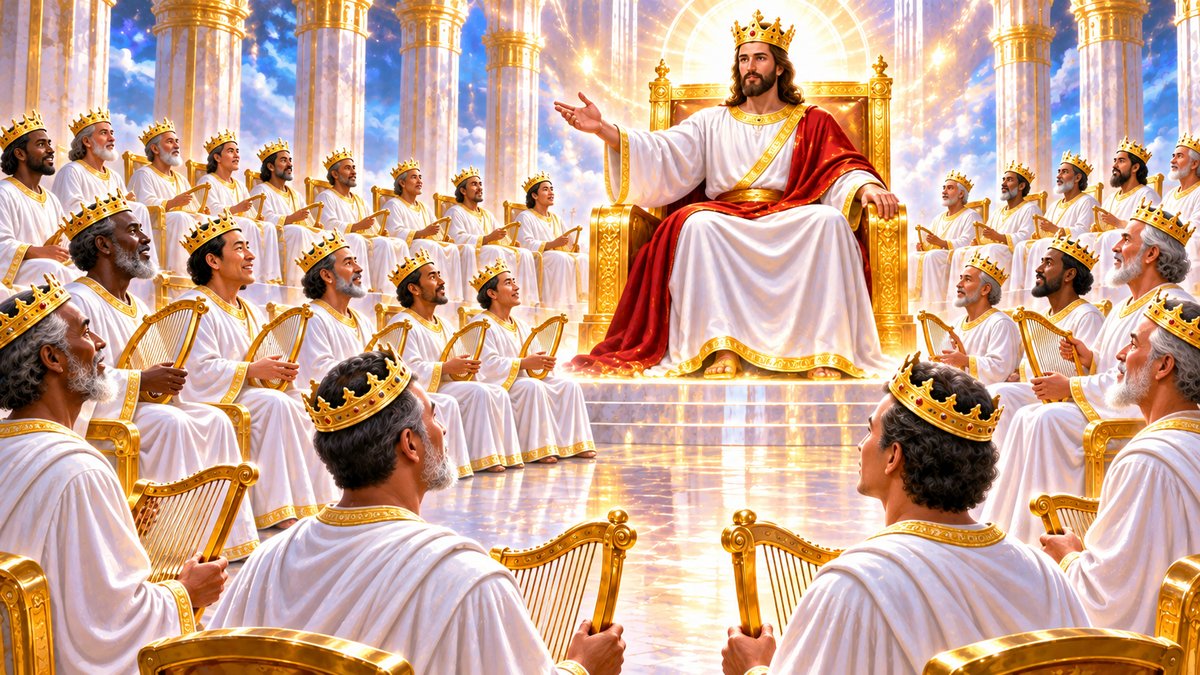
The twenty-four elders that John saw around the throne of God seem to serve as governmental leaders, as well as spiritual leaders. They sit on thrones, wearing crowns, and singing this song to Jesus, the Lamb of God,
“You are worthy to take the scroll,
And to open its seals;
For You were slain,
And have redeemed us to God by Your blood
Out of every tribe and tongue and people and nation,
And have made us kings and priests to our God;
And we shall reign on the earth.”
—Revelation 5:9–10 (NKJV)
Governmental leadership has been part the role of the elders of God’s people since the time of Moses.
Even before Israel had a king, God ordained the elders to represent the leadership in their dealings with the people.
“And the Lord said to Moses, Gather for Me seventy men of the elders of Israel whom you know to be the elders of the people and officers over them; and bring them to the Tent of Meeting and let them stand there with you.
“And I will come down and talk with you there; and I will take of the Spirit which is upon you and will put It upon them; and they shall bear the burden of the people with you, so that you may not have to bear it yourself alone.”—Numbers 11:16–17 (AMPC)
And later, when Israel became a kingdom, the elders often worked alongside the king, conducting the business of the kingdom.
It was the elders who anointed David to be king over Israel.
“So all the elders of Israel came to the king at Hebron, and David made a covenant with them there before the Lord, and they anointed [him] king over Israel, according to the word of the Lord through Samuel.”—1 Chronicles 11:3 (AMPC)
The elders were with David when he brought the Ark of the Covenant back to Jerusalem. (See 1 Chronicles 15:25.)
Later, when Solomon was ready to bring the Ark into the newly constructed temple, he assembled the elders and other governmental leaders.
“Then Solomon assembled the elders of Israel and all the heads of the tribes, the leaders of the fathers’ households of the Israelites, in Jerusalem to bring the ark of the covenant of the Lord up from the City of David, which is Zion.”—2 Chronicles 5:2 (AMP)
When judgment came upon Israel after David numbered the people, the elders were with him to witness God’s judgment. (See 1 Chronicles 21:16.)
When King Josiah was ready to make a covenant to walk in obedience to the Lord, he summoned the elders to be with him.
“King Josiah sent word and they brought to him all the elders of Judah and of Jerusalem. The king went up to the house of the Lord, and with him all the men of Judah and all the inhabitants of Jerusalem, the priests, the prophets, and all the people, both small and great; and he read in their hearing all the words of the book of the covenant which was found in the house (temple) of the Lord. The king stood by the pillar and made a covenant before the Lord, to walk after the Lord and to keep His commandments, His testimonies, and His statutes with all his heart and soul, to confirm the words of this covenant that were written in this book. And all the people entered into the covenant.”—2 Kings 23:1–3 (AMP)
In the time of Ezra and Nehemiah, King Darius of Babylon issued an executive decree to allow the Jewish elders to work with their governor to rebuild the temple of God. (See Ezra 6:7.)
Leaders and Representatives
Elders were included in the major decisions and plans of God’s people. Elders acted as leaders and representatives of the people.
When it was time for Moses to turn over leadership to Joshua, Moses summoned the elders to hear his final words for the people of Israel.
“Assemble before me all the elders of your tribes and your officers, so that I may speak these words in their hearing”—Deuteronomy 31:28 (AMP)
Joshua also assembled the elders to hear his final words before Israel transitioned into the time when the judges ruled the people.
“Then all the tribes of Israel met together at Shechem. Joshua called them all together there. Then he called the elders, heads of families, judges, and officers of Israel. These men stood before God.”—Joshua 24:1 (ICB)
When the people of Gilead were desperate for a man who would lead them into battle against the Ammonites, it was the elders who went to implore Jephthah to be their leader in Judges chapter 11.
There are other examples of the elders serving as representatives of God’s people in the times of Ezra the priest, and the prophets Isaiah, Jeremiah, Ezekiel, and Joel.
“In the seventh year, in the fifth month, on the tenth of the month [after the beginning of the exile in Babylon], certain of the elders of Israel came to inquire of the Lord and sat down before me.”—Ezekiel 20:1 (AMP)
“Declare a holy fast; call a sacred assembly. Summon the elders and all who live in the land to the house of the Lord your God, and cry out to the Lord.”—Joel 1:14 (NIV)
Judges and Governors
God instructed the elders of Israel to serve as governors and judges to settle disputes among the people. Elders are mentioned twenty times in the book of Deuteronomy alone.
In the New Testament, Jesus seems to indicate that this role will continue into His millennial reign, with the apostles serving as judges.
“You have stayed with me in my time of trial. And just as my Father has granted me a Kingdom, I now grant you the right to eat and drink at my table in my Kingdom. And you will sit on thrones, judging the twelve tribes of Israel.”—Luke 22:28–30 (NLT)
Late in their ministries, Peter and John were already referring to themselves as elders. This may be an indication that they knew that the roles of the five-fold ministry would not be continuing into the millennial reign of Christ, but the roles of the elders would go on.
“And now, a word to you who are elders in the churches. I, too, am an elder and a witness to the sufferings of Christ. And I, too, will share in his glory when he is revealed to the whole world. As a fellow elder, I appeal to you”—1 Peter 5:1 (NLT)
“This letter is from John, the elder.”—3 John 1:1 (NLT)
Witnesses
The elders of Israel also served as witnesses. The twenty-four elders in God’s throne room sit as witnesses to all He is doing.
When Boaz met with his near kinsman to redeem his right to marry Ruth, he gathered the city elders to be his witnesses. (See Ruth chapter 4.)
Witnesses are important in God’s Kingdom.
The Lord says, “You people are my witnesses and the servant I chose. I chose you so that you would help people believe me. I chose you so that you would understand that ‘I Am He’—I am the true God. There was no God before me, and there will be no God after me.”—Isaiah 43:10 (ERV)
John Paul Jackson had an experience in which God told him that He never did anything without a witness.
“A matter must be established by the testimony of two or three witnesses.”—Deuteronomy 19:15 (NIV)
“But if they won’t listen, take with you one or two others so that every word may be established by the mouth of two or three witnesses.”—Matthew 18:16 (CEB)
Respected Wise Counselors
Elders historically have acted as counselors and advisors to the king. When Ben-hadad of Syria threatened the king of Israel, the king called for the elders to witness the unjust threats and to offer their counsel.
“Then the king of Israel called together all of the elders of the land and told them, ‘Please note that this man is here looking for trouble. He sent a message to me, demanding my wives, my children, and my silver and gold, and I haven’t refused him.’
“Don’t listen to him,” all the elders and the people replied. “And don’t agree to his terms.”—1 Kings 20:7–8 (ISV)
When Israel was dealing with a serious problem of moral corruption, consequences were determined by the counsel of the elders.
“Whoever would not come within three days would forfeit his assets and be separated from the community of the returning exiles, just as the high officials and elders had advised.”—Ezra 10:8 (ISV)
When the priests and the “prophets” rose up against Jeremiah and threatened to kill him for the words he had spoken against them in God’s name, the elders rose up in Jeremiah’s defense and wisely cautioned them against killing the prophet who was speaking in the name of God.
“Some of the elders of the land got up and told all the assembled people, ‘Micah of Moresheth prophesied during the reign of Hezekiah king of Judah to all the people of Judah, “This is what the Lord of the Heavenly Armies says:
‘Zion will be a plowed field,
and Jerusalem a ruin.
The Temple Mount will be a wooded hill.’”“Did Hezekiah king of Judah or anyone in Judah kill him? Didn’t he fear the Lord and seek the Lord’s favor, and so the Lord changed his mind about the disaster that he had spoken to them about. We’re bringing great disaster on ourselves.”—Jeremiah 26:19 (ISV)
Bearers of the Legacy
In their defense of Jeremiah, the elders recounted the lessons of history. This illustrates the value of the elders as bearers of the history and legacy of the kingdom.
“Remember the days of old; consider the years of many generations. Ask your father and he will show you, your elders, and they will tell you.”—Deuteronomy 32:7 (AMPC)
God specifically instructed parents to pass down the lessons from the past to their children. That role in the kingdom was entrusted to the elders. It is still just as important today for parents and elders to remind the younger generations of the history of God’s goodness and faithfulness, recounting specific examples from the past.
“So Joshua called the twelve men whom he had chosen from the people of Israel, one man from each tribe. Joshua told them, “Cross over again in front of the ark of the Lord your God into the middle of the Jordan River. Then each of you pick up a stone on his shoulder with which to build a memorial, one for each of the tribes of Israel. Let this serve as a sign among you, so that when your children ask in times to come, ‘What do these stones mean to you,’ then you’ll say to them, ‘Because the waters of the Jordan River were cut off in front of the Ark of the Covenant of the Lord. When it crossed the Jordan River, the waters of the Jordan were cut off.’ So these stones will become a memorial to the Israelis forever.”—Joshua 4:4–7 (ISV)
From the earliest history of the people of God, elders have been trusted stewards of the history and legacy of God’s dealings with His people.
“So Moses wrote this Law and gave it to the priests, the sons of Levi who carried the ark of the covenant of the Lord, and to all the elders of Israel.”—Deuteronomy 31:9 (NASB)
Elders add value to the community of God’s people because they have been first-person witnesses to so many wonderful works of the Lord! Elders have been witnesses to God’s faithfulness for generations and can pass down those testimonies to younger generations so that the legacy continues.
“The people of Israel served the Lord throughout the lifetime of Joshua and of the elders who outlived him—those who had personally experienced all that the Lord had done for Israel.”—Joshua 24:31 (NLT)
In Revelation also, we see in the twenty-four elders recounting the wonderful acts of God in their worship.
“Now when He had taken the scroll, the four living creatures and the twenty-four elders fell down before the Lamb, each having a harp, and golden bowls full of incense, which are the prayers of the saints. And they sang a new song, saying:
“You are worthy to take the scroll,
And to open its seals;
For You were slain,
And have redeemed us to God by Your blood
Out of every tribe and tongue and people and nation,
And have made us kings and priests to our God;
And we shall reign on the earth.”
—Revelation 5:8–10 (NKJV)
The twenty-four elders in the throne room of Heaven also shared special insight that was not given to other believers. We will see that these twenty-four elders are privileged members of God’s inner circle of trusted confidants.
Back: Why Are Twenty-Four Elders Around the Throne of God?