A Deeper Dive Into the Book of Revelation - Part 89
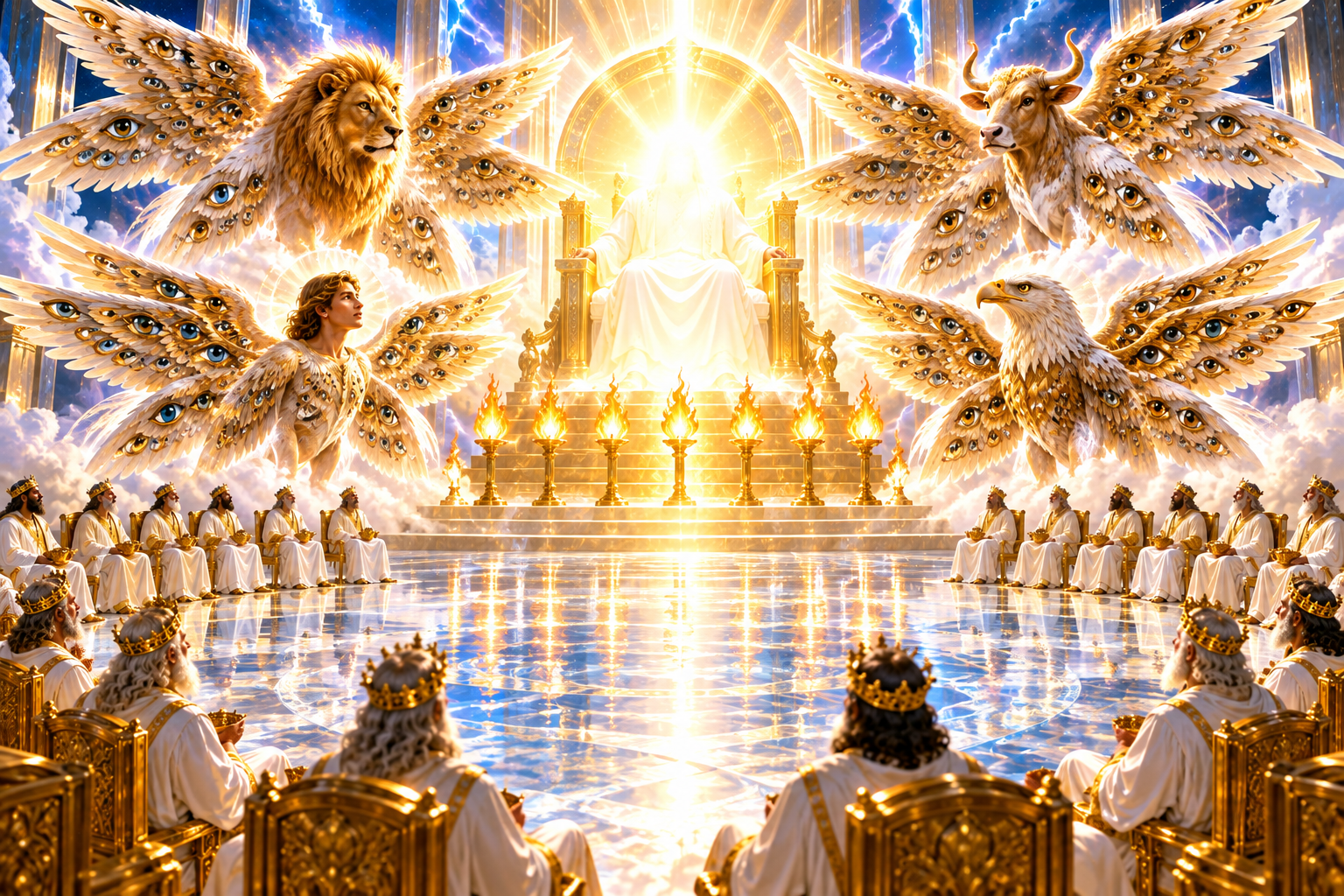
“Around the throne were twenty-four thrones, and seated on the thrones were twenty-four elders, clothed in white garments, with golden crowns on their heads.”—Revelation 4:4 (ESV)
Why are these twenty-four elders seated around the throne? What role do they fulfill? Why would God have twenty-four people seated so close to Him in the throne room of Heaven?
We can get some clues by looking at the roles of elders throughout the Bible. As we do, we will discover that these twenty-four elders are not one-dimensional. They fulfill several roles in the throne room of Almighty God.
Ordained in Every Church
When the apostles established new churches in the book of Acts, they appointed elders to lead and guide those churches.
“And when they had appointed and ordained elders for them in each church with prayer and fasting, they committed them to the Lord in Whom they had come to believe”—Acts 14:23 (AMPC)
“I left you on the island of Crete so you could complete our work there and appoint elders in each town as I instructed you.”—Titus 1:5 (NLT)
While these early churches may not have had pastors or worship leaders, it seems to have been a requirement for them to have elders.
Leaders Alongside the Apostles
The New Testament elders seemed to serve side-by-side with the apostles to provide leadership to the churches.
In Acts chapter 15, when a question arose about whether Gentile believers needed to be circumcised, Paul and Barnabas took the question to the apostles and elders in Jerusalem for clarification and guidance.
In that situation, the elders and the apostles met together, discussed the issue, and together they issued their decision in a letter giving guidance to the Gentile believers:
“This letter is from the apostles and elders, your brothers in Jerusalem. It is written to the Gentile believers in Antioch, Syria, and Cilicia.”—Acts 15:23 (NLT)
As Paul and Silas traveled through Asia they instructed the believers to follow the guidance handed down from the apostles and elders.
“Then they went from town to town, instructing the believers to follow the decisions made by the apostles and elders in Jerusalem.”—Acts 16:4 (NLT)
When Paul returned to Jerusalem, he met, not only with James, but also with the elders and gave them a report about his missionary journey.
“The next day Paul went with us to meet with James, and all the elders of the Jerusalem church were present. After greeting them, Paul gave a detailed account of the things God had accomplished among the Gentiles through his ministry.”—Acts 21:18-19 (NLT)
Peter and John, who were apostles, sometimes referred to themselves as elders. They served in both roles to offer leadership and guidance to the believers of their time. Both roles were highly respected in the New Testament churches.
“This letter is from John, the elder.”—2 John 1 (NLT)
As the Church transitions into the eternal Kingdom of God in the book of Revelation, the role of the apostle seems to disappear, while the role of elder is still very clearly in place. There is no mention of anyone serving in the role of apostle in the book of Revelation. That role seems to be mentioned only in the past tense and only in connection with ministry on earth. This may indicate that the role of apostle is temporary and is no longer needed in Heaven, while the role of the elder is eternal.
Spiritual Leaders by Example
New Testament elders were spiritual leaders among God’s people. They were honored as some of the most mature believers in their churches, and they were looked up to as examples for other believers to follow. They were expected to care for the believers in their churches as spiritual parents caring for those who were growing in their faith.
“And now, a word to you who are elders in the churches. I, too, am an elder and a witness to the sufferings of Christ. And I, too, will share in his glory when he is revealed to the whole world. As a fellow elder, I appeal to you: Care for the flock that God has entrusted to you. Watch over it willingly, not grudgingly—not for what you will get out of it, but because you are eager to serve God. Don’t lord it over the people assigned to your care, but lead them by your own good example. And when the Great Shepherd appears, you will receive a crown of never-ending glory and honor.”—1 Peter 5:1-4 (NLT)
In addition to spiritual leadership, elders were also expected to take the lead in ministering healing to believers who were suffering from sickness.
“Are any of you sick? You should call for the elders of the church to come and pray over you, anointing you with oil in the name of the Lord. Such a prayer offered in faith will heal the sick, and the Lord will make you well. And if you have committed any sins, you will be forgiven.”—James 5:14-15 (NLT)
Worship Leaders
In the throne room of God, we see the elders—more than once—spontaneously worshipping God, while others in the throne room join in these acts of worship. This was one of the first things that John witnessed when he entered the throne room of God.
“Whenever the living creatures give glory and honor and thanks to Him who sits on the throne, who lives forever and ever, the twenty-four elders fall down before Him who sits on the throne and worship Him who lives forever and ever, and cast their crowns before the throne, saying:
“You are worthy, O Lord,
To receive glory and honor and power;
For You created all things,
And by Your will they exist and were created.”
—Revelation 4:9-11 (NKJV)
The elders often join in worship with the four living creatures in the throne room. We see this again in the next chapter after Jesus, the Lamb of God, takes the sealed book from the hand of His Father God.
“Then I looked, and I heard the voice of many angels around the throne, the living creatures, and the elders; and the number of them was ten thousand times ten thousand, and thousands of thousands, saying with a loud voice:
‘Worthy is the Lamb who was slain
To receive power and riches and wisdom,
And strength and honor and glory and blessing!’
“And every creature which is in heaven and on the earth and under the earth and such as are in the sea, and all that are in them, I heard saying:
‘Blessing and honor and glory and power
Be to Him who sits on the throne,
And to the Lamb, forever and ever!’
“Then the four living creatures said, ‘Amen!’ And the twenty-four elders fell down and worshiped Him who lives forever and ever.”—Revelation 5:11-14 (NKJV)
We see the elders worshipping alongside the four living creatures again after the destruction of the great harlot in Revelation 19:
“The twenty-four elders and the four living creatures fell down and worshipped God, who is seated on the throne, and they said, ‘Amen. Hallelujah!’”—Revelation 19:4 (CEB)
Entrusted with Special Insight
When the seventh trumpet sounds, signaling the end of the Great Tribulation period and the return of the Lord Jesus to earth, the elders again fall upon their faces and worship God in the throne room.
This time, the words that they speak reveal that these elders have special insight into what is happening and what is going to happen. They have clear understanding about prophetic events that others don’t have.
“Then the seventh angel sounded; and there were loud voices in heaven, saying,
“The kingdom of the world has become the kingdom of our Lord and of His Christ; and He will reign forever and ever.” And the twenty-four elders, who sit on their thrones before God, fell on their faces and worshiped God, saying,
“We give You thanks, Lord God, the Almighty, the One who is and who was, because You have taken Your great power and have begun to reign. And the nations were enraged, and Your wrath came, and the time came for the dead to be judged, and the time to reward Your bond-servants the prophets and the saints and those who fear Your name, the small and the great, and to destroy those who destroy the earth.”—Revelation 11:15-18 (NASB)
Their words show that these twenty-four elders have deep wisdom and understanding about prophetic events. They seem to be trusted stewards of God’s secrets.
We see this again in Revelation chapter 7 when one of the elders explains to John who he is looking at when John sees a great multitude of people suddenly standing before the throne of God wearing white robes and holding palm branches. John had no idea who these people were, but the elder had clear understanding and was able to explain to John who these people were and where they came from.
Kings and Priests
We get more insight into the roles of the twenty-four elders when Jesus, the Lamb of God, takes the sealed book (or scroll) from the hand of His Father in Revelation chapter 5. Again, the elders fall down in worship, and their words and actions here give us important clues about their roles in God’s Kingdom.
“And when He had taken the scroll, the four living creatures and the twenty-four elders fell down before the Lamb (Christ), each one holding a harp and golden bowls full of fragrant incense, which are the prayers of the saints (God’s people).”—Revelation 5:8 (AMP)
Here, the elders are holding bowls of incense. In the ministry of the Old Testament tabernacle, incense was only used in ministry by the priests.
Are these elders also priests unto the Lord? Are they fulfilling the roles of priests in the Kingdom of God?
Yes! Their own words confirm this.
“And they sang a new song, saying:
“You are worthy to take the scroll,
And to open its seals;
For You were slain,
And have redeemed us to God by Your blood
Out of every tribe and tongue and people and nation,
And have made us kings and priests to our God;
And we shall reign on the earth.”
—Revelation 5:9-10 (NKJV)
These elders are serving in the roles of priests unto God. It is very likely that the role of the priest was not something that God created only for the people of Israel in Old Testament times, but that the Jewish priest was patterned after a role which had already been established in Heaven and may continue eternally in the Kingdom of God.
These scriptures clearly indicate that the twenty-four elders around the throne of God are spiritual leaders in the Kingdom of Heaven.
As we continue to examine the words and actions of these elders, we will also see that they fulfill the roles of governmental leaders in God’s Kingdom.
Back: Who Are the Twenty-Four Elders?
Additional Resources
- Study Guide: The Identity and Roles of the Twenty-Four Elders in Revelation (PDF)
- Concept Breakdown: Understanding the Twenty-Four Elders of Revelation (PDF)
- From Earthly Shepherds to Heavenly Thrones: A Comparative Guide to Biblical Eldership (PDF)
- Heavenly Governance as Earthly Blueprint: A Leadership Assessment Framework for Christian Institutions (PDF)
- Theological Position Paper: The Office, Function, and Eternal Implications of Biblical Eldership (PDF)