A Deeper Dive Into the Book of Revelation - Part 62
The Messenger
“And to the angel (divine messenger) of the church in Thyatira write …”—Revelation 2:18 (AMP)
The Thyatirean Church Age was the longest of the seven church ages, lasting almost 1,000 years from the mid-to-late 500s to about 1520 near the beginning of the Reformation. This was also the darkest of the church ages so far. The light of the true Gospel of Jesus Christ had almost been completely put out through the efforts of the Antichrist spirit working in the false church. That is why these years are known as the Dark Ages.
Near the beginning of this church age, a remarkable minister of the Gospel named Columba left Ireland to minister in Scotland. Columba was most likely the predominant messenger to the Thyatira Church Age. God spoke audibly to Columba, calling him into missionary service. This wonderful minister of the Gospel had a real love of Scripture and committed much of the Bible to memory. He shared the Truth of the Gospel throughout Scotland, leading many pagan rulers and their people to Christ and winning virtually the entire nation to the Lord. His ministry was marked by words of prophecy, the gifts of the Holy Spirit, and many miraculous signs and wonders.
“In one of his missionary journeys, as he approached a walled city, he found the gates barred against him. He lifted his voice in prayer that God might intervene and allow him access to the people in order to preach. But as he prayed the court magicians began to harass him with loud noises. He then began to sing a psalm. As he sang, God so increased the volume of his voice that he drowned out the cries of the heathen. Suddenly the gates burst open of their own accord. He entered in and preached the Gospel, winning many to the Lord.
“On another occasion when he was also shut out from a village, as he turned away to depart, the son of the chief suddenly became violently ill, even unto death. Saint Columba was quickly sought after and recalled. When he prayed the prayer of faith the boy was instantly healed. The village was then opened to evangelization by the Gospel.” (Branham, p.218-219)
Columba’s miracle ministry started in much the same way that Jesus’ miracle ministry started—by changing water into wine.
While he was still a young man in Ireland, as the ministers were preparing for one church meeting, Columba overheard these ministers complaining that there was no wine for the communion service. Columba, full of faith, went to a fountain of pure spring water. After taking water from the spring, Columba blessed the water in the name of the Lord Jesus Christ. He then carried the container back to the ministers and announced, “Here is wine, which the Lord Jesus hath sent, for the celebration of His mysteries.” The astonished ministers gave thanks to God and used the wine from that container to minister communion to the congregation that day.
Columba’s miracle ministry was used, just like Jesus’ ministry, to meet the needs of people and to turn them to the Truth of the Gospel message. This true prophet of God was a bright, shining light to the world during a very dark time in Church history.
Columba may have been the predominant messenger to the Thyatirean Church Age, but he was not alone. There were many, many true disciples of Christ during this age who stood firm in their faith and who were willing to lay down their lives and face death rather than to compromise the Truth of the Gospel or to deny the Lord Jesus whom they loved.
Jesus Reveals Himself
“The Son of God, who has eyes like a flame of fire, and feet like burnished bronze, says this”—Revelation 2:18 (NASB)
As Paul Keith Davis points out, this is the only time in the entire book of Revelation where Jesus refers to Himself as the Son of God.
Why?
Jesus always uses the perfect words at just the right moments. His words are always carefully chosen and very precise.
Jesus refers to Himself here as the Son of God because in the ancient city of Thyatira, the people worshiped Apollo, who was supposed to be the “sun god” and the son of Zeus, who was the “father god” of the pagan Romans. Here Jesus sets the record straight. He is the one true Son of God. There is no Son of God besides the Lord Jesus Christ.
This replacement of the true Son of God with a pagan counterfeit became a real issue during the 1,000-year Thyatirean Church Age. During these Dark Ages, pagan beliefs and practices were mixed and co-mingled with Christian beliefs, corrupting the truth of the Gospel message. This is the leaven that Jesus warned us about in the 4th parable of the Kingdom in Matthew 13:33:
“The kingdom of heaven is like leaven, which a woman took and hid in three measures of meal till it was all leavened.” (NKJV)
Pagan idols and images were renamed and installed in church buildings throughout the world. Images of the pagan “Queen of Heaven” and her child were renamed as Mary and Jesus.
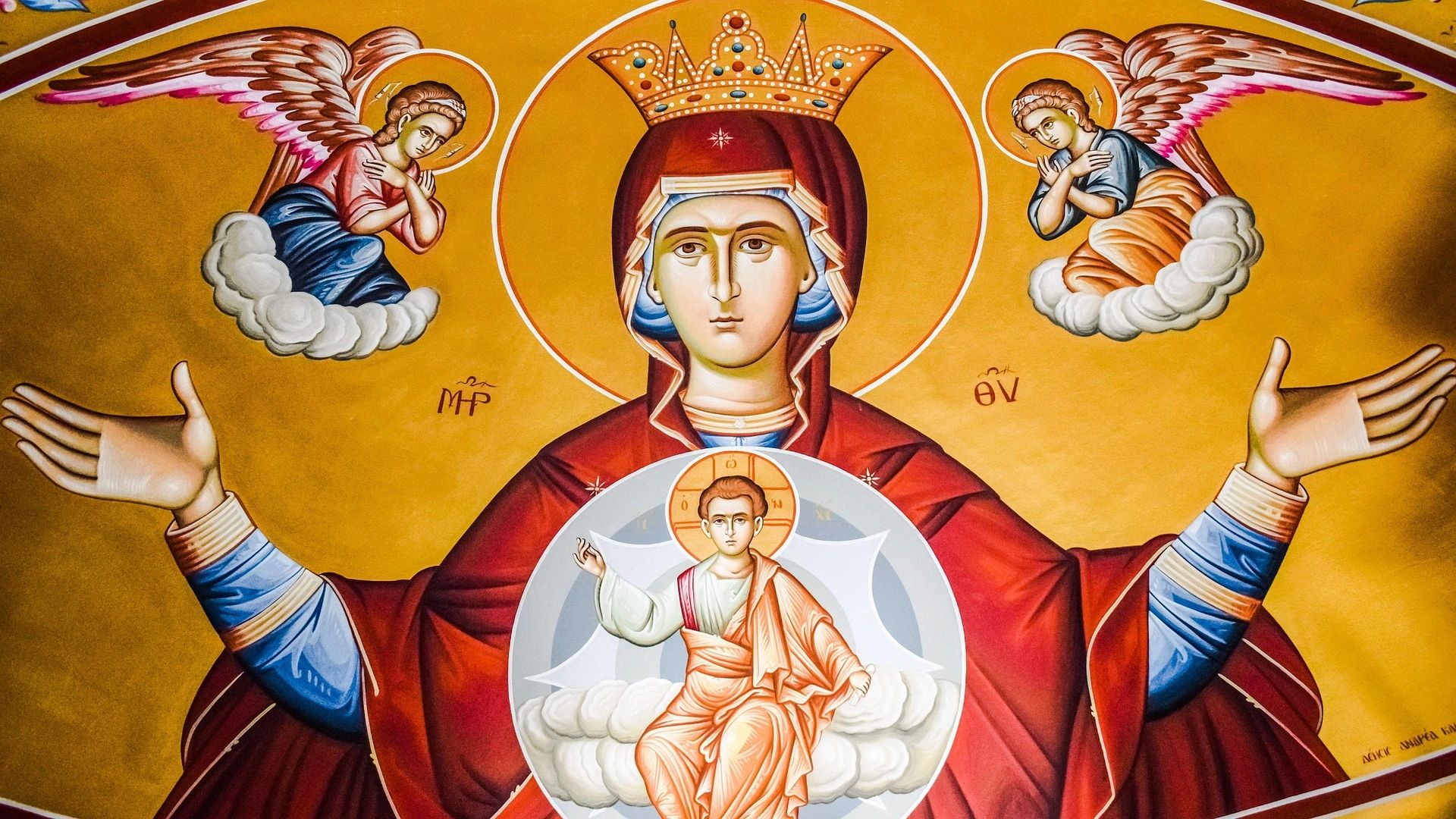
In reality, worship of the “mother and child” idols originated with Nimrod, who was the founder of Babylon. After Nimrod’s death, his mother, Semiramis, was inspired to create a cult around herself and her son Nimrod. Semiramis, who was a Jezebel-type figure, promoted herself as the “Queen of Heaven” and her son Nimrod as the “divine son of heaven.” That Babylonish, pagan worship of “mother and child” has been expressed in other cultures under different names: sometimes as Isis and Osiris; sometimes as Rhea and Tammuz. During the Thyatira Church Age, the mother and child images found a new home in the false church, renamed as Mary and Jesus. These images are still found in thousands of church buildings around the world today as symbols integral to the false church that is revealed in Revelation 17 as “Babylon the Great, the Mother of Harlots and of the Abominations of the Earth.”
God’s people provoked Him to anger with this during the time of Jeremiah.
“Do you not see what they are doing in the cities of Judah and in the streets of Jerusalem? The children gather wood, the fathers kindle the fire, and the women knead dough to make sacrificial cakes for the queen of heaven; and they pour out drink offerings to other gods in order to provoke Me to anger.”—Jeremiah 7:17-18 (NASB)
And again during the time of Ezekiel:
“In the sixth year, on the fifth day of the sixth month, I had just sat down in my house, with the elders of Judah seated in front of me. All of a sudden, the hand of the Lord God touched me** **and I saw a likeness comparable to the appearance of a man. From his thighs downward there was the appearance of fire, and from his waist upward, there was the appearance of brightness that looked like brass.
“The form of a hand reached out and took me by the hair of my head. Then the Spirit lifted me up between the earth and sky, brought me toward Jerusalem, and in visions that came from God took me through the doors of the inner gate that faced north, where an image that provoked God’s jealous anger had been erected.
“All of a sudden, the glory of the God of Israel was there! It looked like what I had seen back in the valley.** **Then he told me, ‘Son of Man, look up toward the north.’
“So I looked off toward the north. Suddenly, off toward the north, facing the gate that led to the altar, the image that provoked God’s jealousy was standing near the entrance.
“Then the Spirit told me, ‘Son of Man, don’t you see what they’re doing? The house of Israel practices awful, detestable things here, so I’m going far away from my sanctuary. But you’re about to see things even more detestable than these.’
“Then the Spirit brought me to the entrance of the court. As I watched, all of a sudden, there was a hole in the wall!** **Then he told me, ‘Son of Man, dig through the wall!’ So I dug into the wall. That’s when I uncovered an entrance!
“Then he told me, ‘Go on through that entrance, so you may see** the wicked, detestable things that they’re committing here.’**
“So I entered, looked around, and there was every form of crawling thing, loathsome animals, and all kinds of idols from the house of Israel carved all around the wall. I saw 70 men from the elders of the house of Israel standing among them, including Shaphan’s son Jaazaniah. Each man held a censer in his hand. As the scent of the cloud of incense ascended, the Spirit asked me, ‘Do you see, Son of Man, what the elders of Israel’s house are doing in secret, each in the chamber of his own carved idol? They keep saying, “God doesn’t see us. The Lord has abandoned the land.”’
“Then the Spirit told me, ‘You’re about to see even more detestable practices that they’re doing!’
“Then he brought me to the entrance of the gate to the Lord’s Temple, which faced the north. That’s where I saw women seated, weeping for Tammuz. Then he asked me, ‘Do you see this, Son of Man? You’re about to see even more detestable practices than these.’
“Then he brought me to the inner court of the Lord’s Temple. There, at the entrance to the Lord’s Temple, between the porch and the altar, were 25 men, with their backs toward the Lord’s Temple and facing the east, prostrating themselves to the sun.
“Do you see this, Son of Man?” he asked me. “Is it an insignificant thing for Judah’s house to commit the detestable things that they’re doing here? They’ve filled the land with violence and turned away from me, causing me to become angry again. Look how they’re sniffing with their noses!** I’m going to deal with them in rage and anger. I’ll show neither pity nor compassion. They’ll cry loudly directly in my ears, but I won’t listen to them.”**—Ezekiel 8 (ISV)
In the Lord’s message to the church in Thyatira, after He refers to Himself as the one true Son of God, Jesus goes on to describe Himself as He “who has eyes like a flame of fire, and feet like burnished bronze.” Both of these aspects of Jesus’ appearance are symbolic of judgment.
In Scripture, God is described as three things: God is love; God is light; and *God is a consuming fire. *
The Lord is so provoked by the corruption of the church in Thyatira, that Jesus is seen coming as a consuming fire to execute judgment upon that church which represents the Church during the Dark Ages between 500 and 1500 AD.
Judgment is also seen in the symbolism of Jesus’ “feet like burnished bronze.”
Furniture in the Outer Court of the Tabernacle of Moses was bronze (or brass) because sin was dealt with in the Outer Court. The altar was bronze and the laver was bronze. But after a priest passed into the Inner Court of the Holy Place and the Holy of Holies, the furniture there was gold. There was no more bronze furniture because sin had already been dealt with in the Outer Court.
In Numbers chapter 21, when the people of Israel were suffering from a plague of judgment for their sins, Moses made a bronze serpent and set it on a pole. Anyone who looked to the serpent would be spared from the judgment of sin. This is a picture of Jesus who would be hung on a cross and made sin for us so that we could be made the righteousness of God in Christ (2 Corinthians 5:21).
When Jesus walked the earth at the beginning of the Church age, His feet were shod with the preparation of the Gospel of peace, but when he addresses the church in Thyatira, His feet are “like burnished bronze” as He comes to confront the sin and corruption that He sees there.
This is how Jesus appeared to Ezekiel when the Lord came to judge His people for mixing their worship with idolatry:
“Then I beheld, and lo, a likeness of a Man with the appearance of fire; from His waist downward He was like fire, and from His waist upward He had the appearance of brightness like gleaming bronze.”—Ezekiel 8:2 (AMPC)
Julia Ward Howe may have been picturing Jesus’ feet like burnished bronze when she wrote these lyrics to Battle Hymn of the Republic:
“Mine eyes have seen the glory of the coming of the Lord; He is trampling out the vintage where the grapes of wrath are stored”
As we read further in Jesus’ message to the church in Thyatira, it becomes clear why He is coming to deal out judgment upon that church.
**References: **
Adamnan. (n.d.). Medieval Sourcebook: Adamnan: Life of St. Columba. Fordham University. https://sourcebooks.fordham.edu/basis/columba-e.asp
Branham, W. M. (2005). An Exposition of the Seven Church Ages. Voice of God Recordings. (PDF)
Davis, P. K. (2017a, April 5). Paul Keith Davis | Webinar 67 | “Thyatira—The Jezebel Church”. YouTube. https://www.youtube.com/watch?v=Jq6XP6cF9h4
Davis, P. K. (2017b, May 10). *Paul Keith Davis | Webinar 68 | “Thyatira—Iron Mixed with Clay”. *YouTube. https://www.youtube.com/watch?v=TOCRoBuJA_E
Davis, P. K. (2017c, June 7). Paul Keith Davis | Webinar 69 | Ruling & Reigning. YouTube. https://www.youtube.com/watch?v=hoQocDiv4iQ
GotQuestions.org. (2009, October 22). Who is the Queen of Heaven?. Got Questions. https://www.gotquestions.org/Queen-of-Heaven.html
Grabbe, D. C. (n.d.). What the Bible says about Mother and Child Worship. Bible Tools. https://www.bibletools.org/index.cfm/fuseaction/Topical.show/RTD/CGG/ID/3048/Mother-Child-Worship.htm
Hislop, A. (1858). The Two Babylons. The Two Babylons—Alexander Hislop. https://www.biblebelievers.com/babylon/
Howe, J. W. (1862). Battle Hymn of the Republic. Hymnary.org. https://hymnary.org/text/mine_eyes_have_seen_the_glory