A Deeper Dive Into the Book of Revelation - Part 57
One of the revelations that God gave to William Branham to share with the Church was that each of the seven letters to the seven churches in Revelation 2 and 3 represents a Church Age since the time of Pentecost. Brother Branham taught that the first letter to Ephesus represented the church age at the time of Pentecost until about 170 AD. The last letter to the church in Laodicea represents the last church age before the return of Christ. The characteristics and the conditions that Jesus addressed in each letter have been true of each Church Age since the time of the original apostles.
We understand that each “angel” or messenger represents the pastor of each church at the time of John’s writing, but each angel also represents a particular messenger that God assigned to each Church Age. Each of these messengers was a voice to his age that proclaimed the Truth of the Gospel, holding fast to that truth in spite of all opposition and challenges to the Truth.
During the Sardis age, Martin Luther seemed to be the predominant voice proclaiming God’s Truth in the face of fierce opposition from the false church.
During the Philadelphia age, John Wesley seemed to be the shining star proclaiming the Truth of the Gospel despite continual persecution.
“the messenger to every age, regardless of when he appears or goes, is the one who influences that age for God by means of a Word-manifested ministry.” (Branham, p.76)
This is how Brother Branham envisioned the Seven Church Ages:
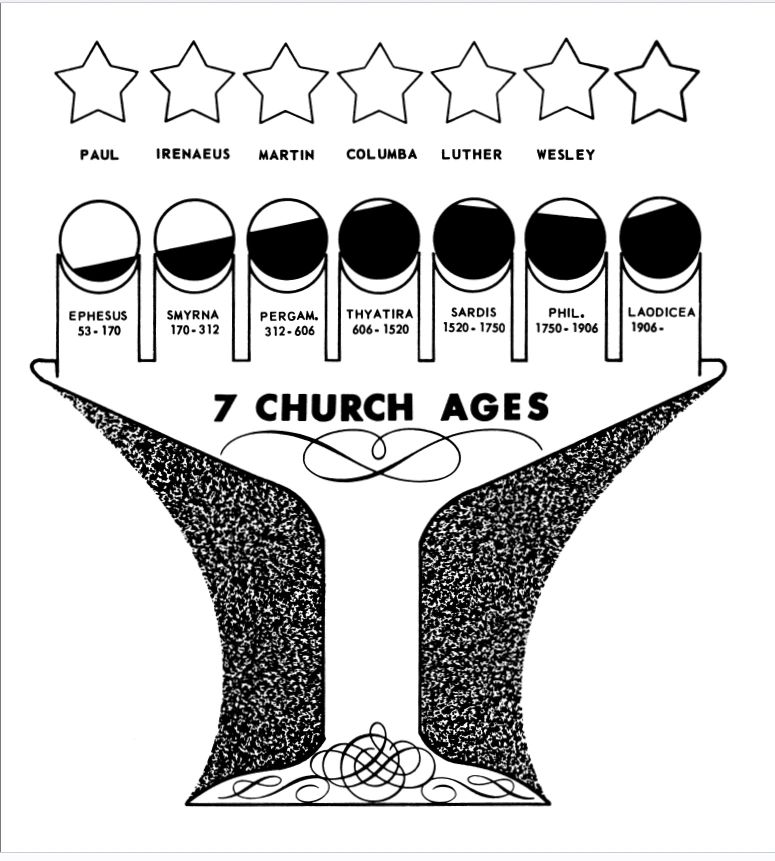
(Branham, p.6)
Brother Branham did not name a messenger for the Laodicean age, but it is my personal belief that William Branham is the main messenger that God has assigned to our Laodicean church age. His life and his ministry demonstrated the uncompromising Truth of the Word of God with signs and wonders from his birth all the way to the last days of his life. He held fast to the Truth of the Gospel throughout his life, emphasizing the foundational doctrines of salvation by faith, the baptism of the Holy Spirit, divine healing, water baptism, the laying on of hands, the resurrection of the dead, and eternal judgment. Sadly, there may have been no other minister in this age who has been more maligned, slandered, and unjustly rejected by established church leaders.
Darkness Increasing
In his illustration of the Seven Church Ages, Brother Branham showed that darkness began increasing in the earth and in the Church since the time of Pentecost.
Similar to stages of an eclipse, we see that the level of darkness began to rise during the Ephesian church age, and it kept rising through the age of the Thyatira church into the Dark Ages just before the Reformation. Then, with the Reformation, God began to restore what Satan had stolen from the Church, and Darkness began to decrease in the earth. Darkness continued to decrease as the light of the Great Awakening drew many people closer to the Lord during the Philadelphia church age.
But then, we see that Darkness again began to increase with the spirit of complacency during our Laodicean church age. Brother Branham prophesied that Darkness would continue to increase in the earth and in the church until great darkness covered the earth just before the return of our Lord Jesus Christ. Brother Branham illustrated these stages of Darkness on a chalkboard during his sermons on the seven church ages.
On Sunday morning, January 8, 1961, Brother Branham had just finished his sermon on Revelation chapter 4 when God came into the room and illustrated the truth of what Brother Branham had been teaching, confirming the words of the prophet.
“He had just finished his message and was about to pray for the sick when the Pillar of Fire appeared in the air at the back of the room, shrinking into a ball of light, looking like a miniature sun. Because Bill was facing his audience, he saw it first. There were approximately 350 people sitting in the pews. They stirred and murmured uneasily, feeling the presence of something supernatural. Then some of them saw a light that appeared on the wall behind the pulpit. Gladys Dauch screamed. Bill turned and looked behind him. This light on the wall behind him was not as intense as the light at the back of the room, but otherwise it was the same in all its features. Bill explained to his audience that the light on the wall behind him was the reflection of that supernatural light at the back of the room. He said, ‘You’re seeing one and I’m seeing two.’
“A series of visions followed. Bill spoke as he watched the visions reveal things. He said, ‘There is a man sitting on the outside here, under this line looking over towards that light. It struck him. He’s from Seymour, Indiana, and he’s had a stroke. Sir, if you’ll believe, God will heal you of that stroke. Amen! Believe now!’
“Lady, do you believe with all your heart? If the Lord God, Creator of heavens and earth, will let me do something to prove to you that this is God, then will you believe with all your heart? You have a nervous condition caused by menopause. Jesus heals you.”
“The lady sitting next to her … you’re not from here either; you’re from Somerset, Kentucky. Even though I’m a stranger to you, I know it’s not you who wants to be made well—it’s your son. He’s in Virginia. He has ulcers, and there is another thing wrong with him—he’s unsaved. You’re praying for him now. Mrs. Baker, return to Somerset and believe with all your heart, and Jesus Christ will make your son well.”
“He continued in the same manner for about fifteen minutes, going in and out of visions regularly. Between each vision he watched that supernatural ball of light at the back of the sanctuary change. Gradually it was darkening like an eclipse of the sun. Its reflection on the wall behind him underwent the same progression, looking like an eclipse of the moon. Every time Bill came out of a vision he saw that more of the disk had darkened. By the time he came out of his third vision, that little sun at the back of the room was almost totally covered by a shadow, its light only a tiny fraction of what it was at first. After two more visions, it lightened a little, but after the next vision it darkened and faded completely away. Each of its seven phases had looked exactly like the circles of the church ages Bill had drawn on his blackboard. Bill explained that symbolically, the sun represents Christ and the moon represents the church. The moon has no light of its own; it merely reflects the light of the sun. Likewise the church merely reflects the light of Christ.
“Many people in the congregation, including Gladys Dauch, watched the waxing and waning of that light on the wall behind the pulpit. They saw all seven stages, the last stage being the darkness of a total eclipse. Bill held this incident in his heart as a confirmation from God that what he taught about the seven church ages was true.” (Jorgensen, Vol.III, p.37-38)
Seven Parables for Seven Church Ages
The seven Church Ages and the seven letters in Revelation 2 and 3 also correspond to the seven parables of the Kingdom in Matthew 13.
The first parable of the Sower corresponds to the first Church Age when the Gospel message was originally spread through the ministries of Jesus, Paul, and the early disciples. This is the age addressed in the letter to the church in Ephesus.
The second parable of the Wheat and the Tares corresponds to the second Church Age in which the children of the devil infiltrated the true Church. This was an age of great persecution and martyrdom. Jesus addressed this in His letter to the church in Smyrna, in which He said, “I know the blasphemy of those who say they are Jews and are not, but are a synagogue of Satan” (Revelation 2:9 NKJV).
The third parable of the Mustard Seed corresponds to the third Church Age in which the Church had become an established institution in society and the fowls of the air (demonic influences and doctrines of devils) had found places to nest. Jesus spoke of this age in His letter to the church in Pergamum.
The fourth parable of the woman hiding leaven in the dough corresponds to the fourth Church age that we historically call the Dark Ages. In this age, the Church was thoroughly corrupted by false doctrines that permeated the institutionalized Church. In Jesus’ letter to the church in Thyatira, we learn the identity of the woman who hid the leaven in the dough.
“Nevertheless I have a few things against you, because you allow that woman Jezebel, who calls herself a prophetess, to teach and seduce My servants to commit sexual immorality and eat things sacrificed to idols.”—Revelation 2:20 (NKJV)
The fifth parable of a man discovering precious hidden treasure corresponds to the fifth Church Age in which God began to reveal and restore the lost truths of the Gospel of the Kingdom during the time of the Reformation. At the beginning of this age, the Church was dead, as Jesus described it in His letter the church in Sardis. They had lost the Truth of the Gospel, and it was forbidden to share the Word of God in the language of the common people. But through the leaders of the Reformation, God began to restore what the enemy had stolen from the Church. Light began to increase after John Wycliffe (who was nicknamed the “Morning Star of the Reformation”) led the efforts to translate the Bible into the language of the common people.
The sixth parable about the Pearl of Great Price corresponds to the sixth Church Age in which many people consecrated themselves to live holy lives unto the Lord during the time of the Great Awakening and the sanctification message of John Wesley. This was also an age of great outreach as missionaries took advantage of opportunities to travel the world spreading the Gospel of Jesus Christ. As Jesus declared in His letter to the church in Philadelphia,
“See, I have set before you an open door, and no one can shut it”—Revelation 3:8 (NKJV)
The seventh parable about the net full of fish corresponds to the seventh Church Age which culminates in the Great Harvest described in Revelation chapter 14. As Jesus said in this parable,
“That is how it will be at the end of the age. The angels will go out, cull out the evil people from among the righteous ones, and will throw them into a blazing furnace. In that place there will be wailing and gnashing of teeth.”—Matthew 13:49-50 (ISV)
Sadly, in this time of urgent preparation for the return of the Lord, the letter to the church of the Laodiceans speaks of a Church that is lukewarm and complacent. Jesus’ message to the Church in our day is one of very stern correction.
“I know your deeds, that you are neither cold nor hot; I wish that you were cold or hot. So because you are lukewarm, and neither hot nor cold, I will vomit you out of My mouth. Because you say, ‘I am rich, and have become wealthy, and have no need of anything,’ and you do not know that you are wretched, miserable, poor, blind, and naked, I advise you to buy from Me gold refined by fire so that you may become rich, and white garments so that you may clothe yourself and the shame of your nakedness will not be revealed; and eye salve to apply to your eyes so that you may see. Those whom I love, I rebuke and discipline; therefore be zealous and repent.”—Revelation 3:15-19 (NASB)
**References: **
Branham, W. M. (2005). An Exposition of the Seven Church Ages. Voice of God Recordings. (PDF)
Davis, P. K. (2016, March 2). Webinar 57 “Seven Messengers” by Paul Keith Davis. YouTube. https://www.youtube.com/watch?v=XxAfWR5U6pc
Jorgensen, Owen. (2011). Supernatural: The Life of William Branham. Supernatural Christian Books.