A Deeper Dive Into the Book of Revelation - Part 58
The Messenger
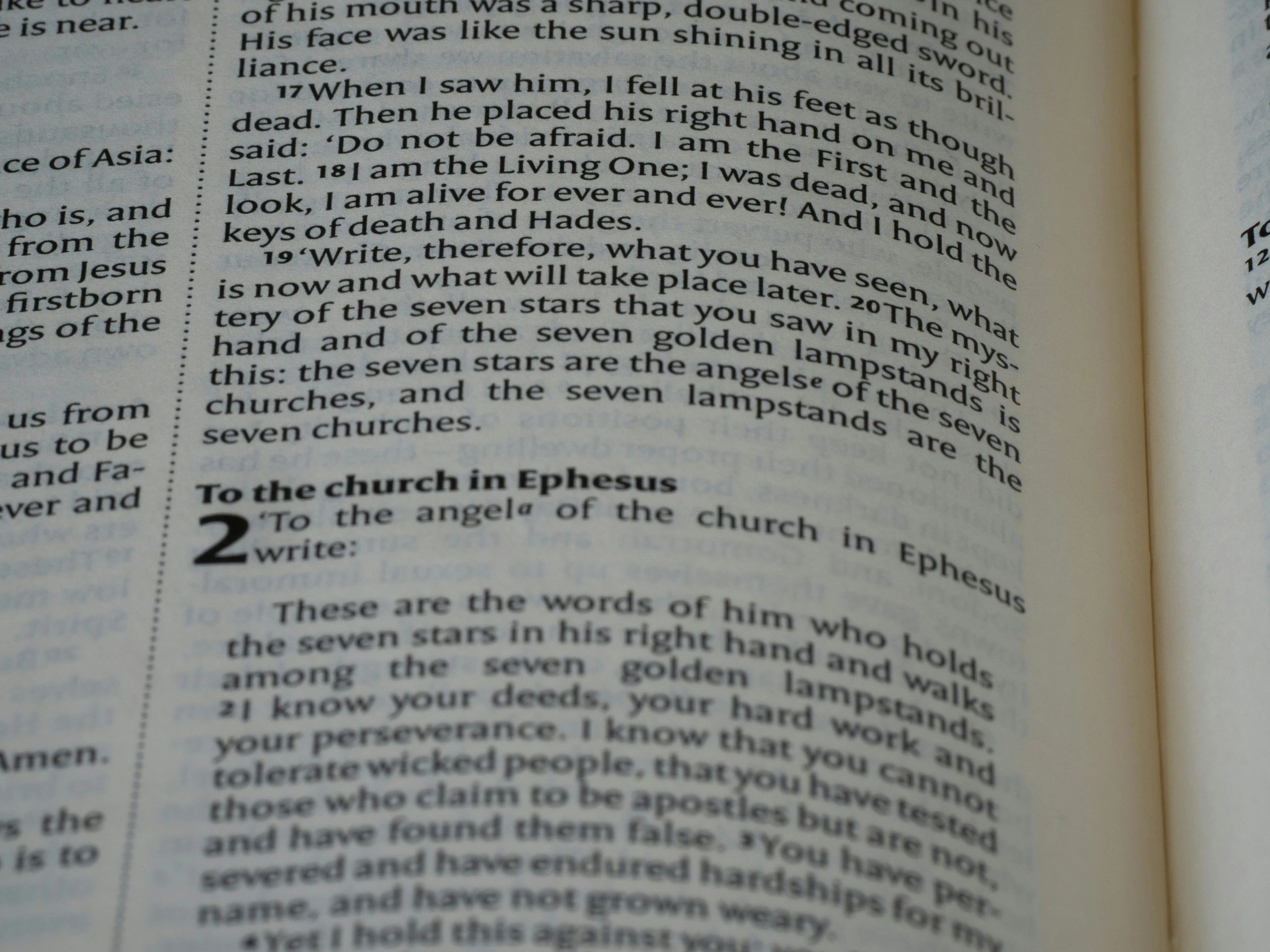
“To the angel (divine messenger) of the church in Ephesus write: …”—Revelation 2:1 (AMP)
Each of the seven messages in Revelation 2 and 3 was entrusted to the “angel” or messenger of that church. God could have simply delivered the message Himself directly to the people of Ephesus, but he chose to work through His servants to accomplish His will. That Is God’s way. He could do everything Himself, but He chooses to work through us, His people.
There are multiple applications of who this “angel” may have been. God’s chosen messenger to the church of Ephesus at that time was probably the pastor of the church. But on a larger scale, as God revealed to William Branham, God also chose one individual to be a primary messenger to the Ephesian Church Age which lasted from the time of Pentecost until about 170 AD.
The messenger to the Ephesian Church Age was probably the Apostle Paul. Paul wrote about half of the books of the New Testament, but more than that, Paul was an uncompromising defender of the Truth of the Gospel of Jesus Christ. As he wrote to the Galatians,
“But even if we, or an angel from heaven, preach any other gospel to you than what we have preached to you, let him be accursed. As we have said before, so now I say again, if anyone preaches any other gospel to you than what you have received, let him be accursed.”—Galatians 1:8-9 (NKJV)
And Paul was not just repeating words that he had been taught in Bible school. Paul received the messages he shared through direct revelation from God.
“For I want you to know, believers, that the gospel which was preached by me is not man’s gospel [it is not a human invention, patterned after any human concept]. For indeed I did not receive it from man, nor was I taught it, but I received it through a [direct] revelation of Jesus Christ.”—Galatians 1:11-12 (AMP)
In his missionary journeys, Paul took the gospel of Jesus Christ beyond the boundaries of Israel, becoming a true apostle to the Gentiles who had never known God before.
“I am saying all this especially for you Gentiles. God has appointed me as the apostle to the Gentiles.”—Romans 11:13 (NLT)
The Apostle Paul may have worked harder, and accomplished more for the sake of Christ and the Gospel than anyone else in the Ephesian Church Age.
“I worked harder than all the other apostles. (But I was not really the one working. It was God’s grace that was with me.)”—1 Corinthians 15:10 (ICB)
Jesus Reveals Himself
“These are the words of the One who holds [firmly] the seven stars [which are the angels or messengers of the seven churches] in His right hand, the One who walks among the seven golden lampstands (the seven churches)”—Revelation 2:1 (AMP)
In this verse, Jesus reveals Himself as the author of the message to Ephesus. But when we compare what He reveals about Himself here with all that He revealed to John, we realize that Jesus is only revealing a small part of Himself to the church in Ephesus. He revealed other parts of Himself to the other six churches.
That should be a lesson for us. God never entrusts everything that He is to any one superstar minister or to any one church or denomination. No one has it all. Churches in Africa and Asia experience Jesus in ways that churches in America may have never experienced Him. We see much more of all that Jesus is when we take into consideration the whole Body of Christ—past, present, and future—the worldwide Church. After all, Jesus tells us here that He walks among all seven churches, not just one or two.
Jesus also tells us here that He holds the churches’ messengers securely in His right hand.
In the Ephesian Church Age, Paul was tested, tried, and severely persecuted, but God always guided and protected His servant, leading Paul to always triumph in Christ Jesus.
Paul seemed to be indestructible as he was held in the right hand of the Lord Jesus. The Jews stoned Paul at Lystra and “dragged him out of the city, thinking he was dead. But the disciples formed a circle around him, and he got up and went back into the city; and the next day he went on with Barnabas to Derbe” (Acts 14:19-20 AMP).
In another death-defying episode, a poisonous snake fastened itself to Paul’s hand while he was in Malta, but Paul simply shook the snake off into the fire and suffered no harm. (See Acts 28:3-5.)
Being held in the right hand of the Lord Jesus Christ, Paul stayed true to the Gospel of Jesus Christ throughout His life. His message was consistent and never strayed from the Truth of the Gospel.
Praise from the Lord
Jesus had a word of correction for the church in Ephesus, but he began his message with praise for their actions and good qualities that pleased Him.
“I know what you’ve been doing, your toil, and your endurance. I also know that you cannot tolerate evil people. You have tested those who call themselves apostles, but are not, and have found them to be false. You have endured and suffered because of my name, yet you have not grown weary.”—Revelation 2:2-3 (ISV)
This Ephesian Church Age was characterized by dedicated labor for the Lord and an intolerance for evil. These believers served the Lord without compromise. Immorality was confronted and dealt with effectively. There was a clear difference between the morality of these believers and the immorality of the world. This was a pure Church that did not compromise their moral standards.
These believers even tested those who called themselves apostles. When these false apostles did not produce the fruit of true apostles, they were exposed to be the false apostles that they were—and Jesus praised the believers for this! How different our churches would be today if believers tested everyone who calls himself an apostle or prophet! How much damage has been done in our churches today by politely accepting every minister without question, only then to be poisoned by the rotten fruit they produce!
The believers of this Ephesian Church Age also suffered persecution because of the name of Christ, but they did not let these sufferings hinder them in any way from pursuing God’s will and seeking His Kingdom first.
The Word of Correction
“Nevertheless I have this against you, that you have left your first love. Remember therefore from where you have fallen; repent and do the first works, or else I will come to you quickly and remove your lampstand from its place—unless you repent.”—Revelation 2:4-5 (NKJV)
The believers of this Ephesian Age were doing a lot of good works, and Jesus praised them for that, but a serious underlying issue had developed. They were doing the works of the ministry, but without love. If love was missing, then they must have had other motivations for doing all of their good works. This is a very serious issue for all of us.
We must all examine our hearts and ask ourselves, “What is my root motivation for doing what I am doing?” If our root motivation is not love for God and love for our neighbor, then we are misguided. We need to have a serious change of heart and correct our root motivations.
Jesus tells us in this message how to make a course correction: “Remember therefore from where you have fallen; repent and do the first works.”
What were we doing when we were on fire with love for God? What were the things that we were doing when our love for God was our primary motivation? What were the things that we were doing when everything that we did came from a heart filed with love for God? Remember what that was like and go back to doing those things. That will correct this issue in our lives.
The potential cost for not dealing with this issue is devastating. Jesus warned, “or else I will come to you quickly and remove your lampstand from its place—unless you repent.”
The cost of not dealing with this issue and repenting for their lack of love would be the loss of their position of authority and responsibility in the Kingdom of God.
This must be like what the wicked, lazy servant experienced in the parable of the talents:
“So take the talent from him and give it to him who has the ten talents. For to everyone who has will more be given, and he will have an abundance. But from the one who has not, even what he has will be taken away. And cast the worthless servant into the outer darkness. In that place there will be weeping and gnashing of teeth.”—Matthew 25:28-30 (ESV)
We must realize that while “the gifts and calling of God are without repentance,” if we choose not to fulfill the responsibilities that God has given to us, He will find someone else who will, and we will lose out on eternal rewards and our positions of responsibility in the Kingdom of God.
The Deeds of the Nicolaitans
After His stern word of correction, Jesus comforts and encourages the believers with one last word of praise.
“But this you have, that you hate the deeds of the Nicolaitans, which I also hate.”—Revelation 2:6 (NKJV)
The Ephesians shared the Lord’s hatred for the works of the Nicolaitans. He praised them for this hatred. As children of God, we are to love good and hate evil.
“Hate the evil, and love the good”—Amos 5:15 (KJV)
“You who love the Lord, hate evil!”—Psalm 97:10 (NKJV)
“The fear of the Lord is hatred of evil. Pride and arrogance and the way of evil and perverted speech I hate.”—Proverbs 8:13 (ESV)
What were these works of the Nicolaitans that provoked such hatred from the Lord?
The word “Nicolaitans” comes from two words, “nikao” and “laos.” “Nikao” means “to conquer” or “to be victorious over.” It is another form of the word “nike,” which means “victory.” “Laos” means “the common people.” It is from this word “laos” that we get the word “laity.” Putting these two words together, “Nicolaitans” means “those who conquer the laity,” or “those who conquer the common people.”
But who would want to conquer the people of God? We see the answer in Revelation 6:2:
“And I looked, and saw there a white horse whose rider carried a bow. And a crown was given him, and he rode forth conquering and to conquer.” (AMPC)
This is the spirit of Antichrist. We see this spirit embodied in the beast rising up out of the sea in Revelation chapter 13:
“It was granted to him to make war with the saints and to overcome them.”—Revelation 13:7 (NKJV)
It is from the works of the Nicolaitans that an ungodly separation was made between the so-called “clergy” and the “laity.” This idea of a division between ministers and the common people was born in hell and inspired by demonic influences.
Jesus clearly told us that there must be no divisions like that among the believers.
“But Jesus called them to Himself and said, ‘You know that the rulers of the Gentiles lord it over them, and those who are great exercise authority over them. Yet **it shall not be so among you; **but whoever desires to become great among you, let him be your servant. And whoever desires to be first among you, let him be your slave— just as the Son of Man did not come to be served, but to serve, and to give His life a ransom for many.’”—Matthew 20:25-28 (NKJV)
In the deeds of the Nicolaitans were sown the seeds of the hierarchy of clergy ruling over the believers and placing themselves as authorities between the people and their God.
These are the beginnings of the false church, the mother of all harlots, that John saw in its full maturity in Revelation 17, sitting on the back of the Antichrist beast.
To the Overcomer
Jesus closed this message (as He closed each of these seven messages) with an extraordinary promise “to him who overcomes.” Until this point, Jesus had addressed his message to the “angel” or messenger of the church. Now Jesus changes His focus. This final promise is not offered to the whole church, but it is only offered to the individual who goes above and beyond what most Christians are willing to do. This promise is only offered to the individual who overcomes!
What does it take to be an overcomer?
Jesus identified issues to be corrected in these seven messages to the churches. An overcomer will be one who overcomes the issues that Jesus has identified in these seven messages, as well as any other personal issues that Jesus brings to their attention.
“He who has an ear, let him hear what the Spirit says to the churches. To him who overcomes I will give to eat from the tree of life, which is in the midst of the Paradise of God.”—Revelation 2:7 (NKJV)
Believers are not all given the same rewards. Jesus tells us in several Scriptural passages that He will reward each of us according to our works. Also, Paul tells us in I Corinthians 3:10-15 that each person’s works will be tried by fire to determine their rewards.
“According to the [remarkable] grace of God which was given to me [to prepare me for my task], like a skillful master builder I laid a foundation, and now another is building on it. But each one must be careful how he builds on it, for no one can lay a foundation other than the one which is [already] laid, which is Jesus Christ. But if anyone builds on the foundation with gold, silver, precious stones, wood, hay, straw, each one’s work will be clearly shown [for what it is]; for the day [of judgment] will disclose it, because it is to be revealed with fire, and the fire will test the quality and character and worth of each person’s work. If any person’s work which he has built [on this foundation, that is, any outcome of his effort] remains [and survives this test], he will receive a reward. But if any person’s work is burned up [by the test], he will suffer the loss [of his reward]; yet he himself will be saved, but only as [one who has barely escaped] through fire.” (AMP)
Also, there are different ranks and levels of authority and responsibility in the Kingdom of Heaven. Some believers will rule and reign in positions of authority very close to the Lord Jesus Himself, while others who did nothing with what the Lord gave them in this life may spend eternity on the very outskirts of Heaven, possibly never even coming near to the throne of God.
The parable of the Sower (the first parable of Mathew 13) corresponds to this Ephesian Church Age. In this parable of the Sower, Jesus lets us know that God sees the Church as three distinct groups of believers, not just one big group.
The first of these three groups are the “stony ground” believers who fall away from the faith when difficulties arise. Then Jesus describes the “thorny ground” believers who get distracted by the cares of this life and the pursuits of other things and never fulfill their potential. The third group of believers correspond to the Overcomers of Revelation. This third group of believers receive the Word of God into hearts of “good soil,” and their lives bring forth good fruit.
These three groups of believers can be seen throughout the Bible in various forms. Their eternal rewards and their positions of authority and responsibility in the Kingdom of Heaven are very different.
We only have to read the 25th chapter of Matthew to see that some wise virgins will join the Lord Jesus in His marriage celebration while others who did not prepare themselves will be locked out.
In this same chapter, we read the parable of the talents in which we see two faithful servants who are rewarded with higher positions of authority and responsibility, while the third servant, who did nothing with what his master had given him loses everything and is cast into outer darkness.
The believer who overcomes the issues that Jesus points out for correction will receive the greatest rewards and the highest positions of authority and responsibility in the Kingdom of Heaven.
“He who overcomes shall inherit all things, and I will be his God and he shall be My son.”—Revelation 21:7 (NKJV)
“How blessed are those who wash their robes so that they may have the right to the tree of life and may go through the gates into the city!”—Revelation 22:14 (ISV)
**Reference: **
Branham, W. M. (2005). An Exposition of the Seven Church Ages. Voice of God Recordings. (PDF)
Davis, P. K. (2016a, August 3). Paul Keith Davis - Webinar 59 “The Ephesian Church - Revelation 2:1-7.” YouTube. https://www.youtube.com/watch?v=0rL8bguSW3w
Davis, P. K. (2016b, September 7). Paul Keith Davis - Webinar 60 “The Victorious Church-Revelation 2: 1-7.” YouTube. https://www.youtube.com/watch?v=F1_WU_AdxIc&t=9s
Davis, P. K. (2016c, October 6). Paul Keith Davis - Webinar 61 - “The Tree of Life-Revelation 2: 1-7.” YouTube. https://www.youtube.com/watch?v=wykMftjXSJw