**The Prophecies of Daniel - Part 3 **
It is no accident that the statue in Nebuchadnezzar’s dream representing world empires is in the image of a man. The image that Nebuchadnezzar saw in his dream was “large and of unsurpassed splendor, … and its appearance was awesome and terrifying” (Daniel 2:31 AMP).
This image was very impressive, captivating, and awe-inspiring. It seemed to symbolize the fullness of man’s greatness. It represents the culmination of the greatest achievements of man through the ages.
It could easily inspire worship and devotion.
And that’s the main problem with this image. Images in Scripture often become objects of worship. They become idols. They stand in the place of God. That is one of the main reasons that this image is destroyed and crushed by the Kingdom of God in the end.
We are warned about making images into idols.
“Do not turn to idols or make for yourselves molten gods (images cast in metal); I am the Lord your God.”—Leviticus 19:4 (AMP)
“Don’t make idols for yourselves. Don’t set up statues or memorial stones in your land to bow down to, because I am the Lord your God!”—Leviticus 26:1 (ERV)
“So be careful! Don’t sin and destroy yourselves by making false gods or statues in the shape of any living thing. Don’t make an idol that looks like a man or a woman”—Deuteronomy 4:16 (ERV)
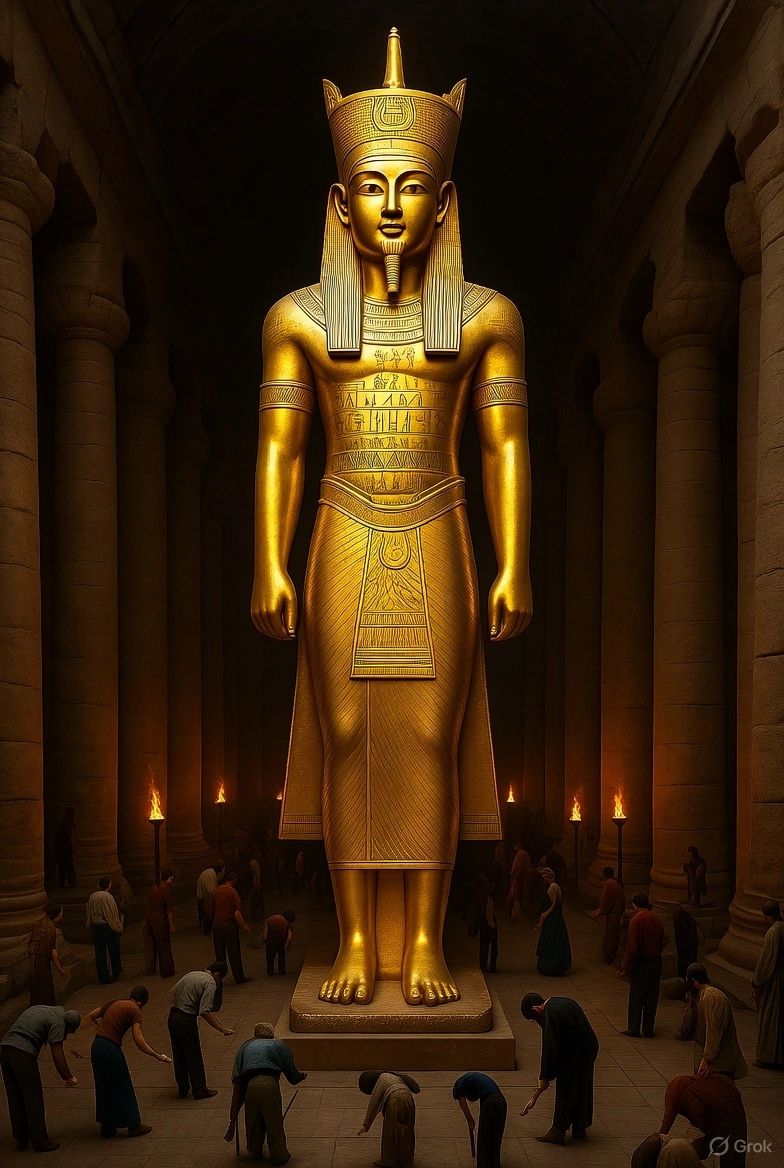
In his dream, Nebuchadnezzar saw an awe-inspiring statue with a head of gold. Daniel explained in the interpretation that the head of gold represented Nebuchadnezzar as the exalted emperor of Babylon.
In the very next chapter, possibly inspired by this dream, Nebuchadnezzar creates a statue of gold and sets it up as an image to be worshiped!
“King Nebuchadnezzar made a gold statue. It was ninety feet high and nine feet wide. He set it up in the Dura Valley in the province of Babylon.** King Nebuchadnezzar then ordered the chief administrators, ministers, governors, counselors, treasurers, judges, magistrates, and all the provincial officials to assemble and come for the dedication of the statue that he had set up. **So the chief administrators, ministers, governors, counselors, treasurers, judges, magistrates, and all the provincial officials assembled for the dedication of the statue that King Nebuchadnezzar had set up. They stood in front of the statue the king had set up.
“The herald proclaimed loudly: ‘Peoples, nations, and languages! This is what you must do:** When you hear the sound of the horn, pipe, zither, lyre, harp, flute, and every kind of instrument, you must bow down and worship the gold statue that King Nebuchadnezzar has set up. **Anyone who will not bow down and worship will be immediately thrown into a furnace of flaming fire.’
“So because of this order as soon as they heard the sound of the horn, pipe, zither, lyre, harp, flute, and every kind of instrument, all the peoples, nations, and languages bowed down and worshipped the gold statue that King Nebuchadnezzar had set up.”—Daniel 3:1-6 (CEB)
The lesson of the dream did not stick with Nebuchadnezzar. He seemed to have completely forgotten that the golden head, along with the rest of the image, was crushed and completely destroyed by the stone representing the Kingdom of the One True God.
Nebuchadnezzar seemed to have completely forgotten what he confessed to Daniel after hearing the interpretation:
“I know for sure your God is the God over all gods and the Lord over all kings. He tells people about things they cannot know. I know this is true because you were able to tell these secret things to me.”—Daniel 2:47 (ERV)
This is a lesson that Nebuchadnezzar would have to learn again in Daniel chapter 3, and again in Daniel chapter 4. Then his son, Belshazzar would learn the lesson too late in Daniel chapter 5. Finally, Daniel’s enemies would learn this hard lesson in Daniel chapter 6.
The Two Languages of the Book
It seems that the entire first half of the book of Daniel is written to testify to the fact that the God of the Hebrews is the only true God and that He is to be worshiped above all others.
The original languages of the book seem to confirm that.
The first chapter of the book was written in Hebrew. Then, in chapter 2 verse 4, the language changed to Aramaic. Then the language of the book changed again in chapter 8, and the last five chapters of Daniel were written in Hebrew.
- Chapter 1 - Chapter 2:4 = Hebrew
- Chapter 2:4 - Chapter 7 = Aramaic
- Chapter 8 - Chapter 12 = Hebrew
Hebrew, of course, was the language of God’s people (the Israelites). Aramaic was the common language of the Gentiles (the non-Jewish people) at that time.
So, it seems that the first chapter was primarily written to God’s people. This gave an introduction to the book, setting up the rest of the book. The first chapter also includes the story of the test of foods showing Daniel submitting to the Babylonian leadership, and yet not compromising his commitments to God. In this way, Daniel’s life was an example for the rest of God’s people.
The Aramaic chapters of the book include the interpretation of Nebuchadnezzar’s dream, the incredible testimony of the three Hebrews surviving the fiery furnace, Nebuchadnezzar’s humbling experience of losing his kingdom and then later being restored in chapter 4, the writing on the wall in chapter 5, and Daniel’s amazing story of surviving the lion’s den without a scratch!
Each of these amazing stories seems to be written in the language of the Gentile people in order to proclaim the glory of God and to show to the Gentiles that the God of the Hebrews is the only true God and the supreme ruler over the affairs of men.
Then, in chapter 8, the language seems to return to Hebrew because the rest of the book of Daniel contains messages for the Hebrew people in particular, like Daniel chapter 9, in which Daniel is told that:
“Seventy weeks are determined for your people and for your holy city”—Daniel 9:24 (NKJV)
The last five chapters of Daniel are messages to God’s people in particular, not to the Gentiles, and so they are written in Hebrew, the language of God’s people, the Israelites.