The Prophecies of Daniel - Part 5
In Nebuchadnezzar’s dream, the final empire of man is represented by the statue’s two legs of iron and the feet of iron mixed with clay. This empire is different from the other empires represented in the statue because it changes in composition from the legs to the feet and also because it seems to continue all the way until the time of the return of Christ.
This fourth empire of Nebuchadnezzar’s statue corresponds to the fourth beast that appeared in Daniel’s night vision in chapter 7. There Daniel writes,
“It was different from all the beasts that came before it”—Daniel 7:7 (AMP)
Daniel’s focus was especially drawn to this fourth beast. He especially wanted to understand the meaning of this fourth beast that seemed so different from the others.
“Then I wished to know the exact meaning of the fourth beast, which was different from all the others, extremely dreadful, with teeth of iron and claws of bronze, which devoured, crushed and trampled down what was left with its feet”—Daniel 7:19 (AMP)
The fourth empire and the fourth beast seem to represent the Roman empire which ruled much of the world for centuries. Rome was the ruling power during the time that Jesus walked the earth.
The Roman empire was eventually divided into Eastern and Western empires, which seem to be symbolized by the two legs of the statue in Nebuchadnezzar’s dream. The Western Roman Empire fell in 476 A.D. while the Eastern Roman empire (also known as the Byzantine Empire) survived until 1453 A.D.
But if the Roman empire fell, how could it continue until Christ’s return if that is what Nebuchadnezzar’s dream indicates? And why does the composition of the statue change from legs of iron to feet of iron mixed with clay?
The answers to these questions become clearer when we follow the evolution of the ancient Roman high priest, who carried the title of Pontifex Maximus.
Pontifex Maximus
The high priest of the ancient Roman pagan religion was the Pontifex Maximus. He led the Collegium Pontificum (the College of Pontiffs). This Pontiff was elected to his position through a voting process.
“The Pontifex Maximus was responsible for overseeing various aspects of Roman spirituality, including the maintenance of religious laws, the supervision of festivals, and the administration of rites in honor of the roman gods and goddesses.” (Maggisano)
Because of his role as high priest overseeing the religious laws and duties, the Pontifex Maximus wielded great power and influence over the Roman citizens in the years before the birth of Christ.
When Caesar Augustus became the first emperor of Rome, he also took the title of Pontifex Maximus, merging political power with religious power. This allowed him to shape religious beliefs and practices and to quell any dissent. It was Augustus who introduced emperor worship, declaring the emperor to be divinely chosen by the gods to rule over the people. Since he was divinely chosen, he could declare that he spoke for the gods, and he could declare any dissent to be sacrilegious and heretical.
It was while Caesar Augustus falsely declared himself to be divinely chosen to rule the people that Jesus Christ, the true King of Kings, was born in Bethlehem, as we read in Luke chapter 2.
Roman emperor worship developed into what became known as the Roman imperial cult. During the first and second centuries after Christ’s crucifixion, many martyrs were executed for refusing to participate in emperor worship at the orders of the Pontifex Maximus.
Roman emperors continued to claim the title of Pontifex Maximus, even after Christianity became the state religion under Constantine during the 300s. Finally, Roman emperor Gratian renounced the title of Pontifex Maximus in 382 A.D. because it was so closely tied to the paganism and idol worship of Rome before Christianity was adopted.
A curious thing happened after the fall of the Roman empire, and this is key to us understanding the feet of iron and clay in Nebuchadnezzar’s dream.
After the fall of the Roman empire, the title of Pontifex Maximus was adopted by the Pope as head of the Catholic Church. In the Annuario Pontificio, which is the official directory of the central governing body of the Catholic Church and Vatican City, the title is officially listed as Summus Pontifex (meaning Supreme Pontiff).
“The term Pontifex Maximus is commonly found in inscriptions on buildings, paintings, statues, and coins about the popes, and is usually abbreviated as “Pont Max” or “P.M” (the popes began to use the title of supreme pontiff in the Italian Renaissance; from then on, the abbreviations “Pont Max” and “P M” appear several times, as in the famous painting of Pope Leo X (r. 1513–1521), by Raphael, in which is written “Leo X Pont (ifex) Max (imus)”, meaning “Leo X, Supreme Pontiff”).” (Wikipedia)
Even the official handle of the Pope on the X platform is @Pontifex. The address of the Pope’s profile on X is x.com/pontifex.
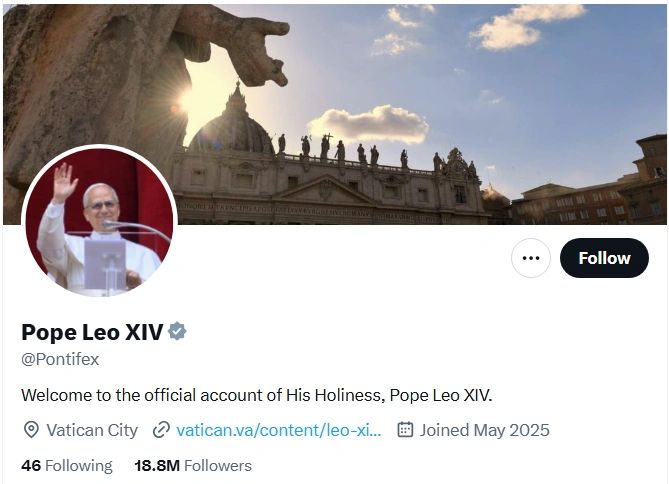
This should be shocking to any Christians who understand the origins and the history of this title. Pontifex Maximus was the high priest of the pagan Roman religion, directing the worship of the false gods of Rome. The Roman Emperor Gratian renounced this title because of its ties to pagan idol worship. Why then would this title be embraced by someone claiming to be a Christian leader?
The term Pontifex Maximus comes from the Latin word “pons” meaning “bridge,” and the adjective “maximus” which means “great.” It reflects the Pope’s role as a bridge builder. But what bridges is he building?
It seems that in adopting this title, the Pope is linking his office to the pagan religion of ancient Rome, as well as the fallen Roman empire.
Today, rather than being called and commissioned by God, the Pope is elected to his position by the College of Cardinals, just like the Pontifex Maximus of ancient Rome was elected to his position by the College of Pontiffs. This carries on the ancient tradition of the pagan Roman religion.
This helps us to understand the feet of iron and clay in Nebuchadnezzar’s dream. The Roman empire, symbolized by legs of iron, is not gone. It lives on in the Roman Catholic Church which embodies the feet of iron and clay in our time. Its governmental strength and power have been significantly weakened after the fall of the Roman empire, but it still commands the hearts and minds of millions of people around the world and influences the governments and rulers of many countries.
In the book of Revelation, we see that this false church—Babylon the Great, the Mother of Harlots—will join forces with the political and military power of the Antichrist to rule the world and violently oppress the true Church during the Great Tribulation period.
The true nature of the Pope’s office is not hidden but is proudly proclaimed in the many titles of the Pope.
The Pope’s title of “Bishop of Rome” acknowledges the Pope’s ties to Rome and the ancient Roman history and traditions.
Another title of the Pope that has been more recently adopted is “Sovereign of the Vatican City State.” This title recognizes his role as leader of the Vatican City State. This acknowledges the Pope as a governmental and political leader as well as a religious leader, acknowledging the combination of the iron mixed with clay.
I don’t believe that the Pope is *the *Antichrist that will arise during the Great Tribulation period, because it seems that the Antichrist will be a governmental leader, rather than a religious leader. The Antichrist seems to be represented by the first beast mentioned in Revelation 13, while the false church seems to be represented by the woman drunk on the blood of the martyrs in Revelation 17.
But as John told us, “Little children, it is the last hour; and as you have heard that the Antichrist is coming, even now many antichrists have come, by which we know that it is the last hour” (1 John 2:18 NKJV).
The Pope seems to be one of many antichrists in the world today. Even now, his titles proclaim that he is standing in the position of Jesus Christ, usurping the position of Christ in the Church, and taking upon Himself titles that are reserved for God alone.
The Pope’s official title of “Summus Pontifex” (Supreme Pontiff of the Universal Church) means that the pope is the “highest priest” in the Catholic Church.
But we already have a High Priest. His name is Jesus. Anyone who sets himself up in the place of Jesus is antichrist.
“Therefore, since we have a great high priest who has ascended into heaven, Jesus the Son of God, let us hold firmly to the faith we profess.”— Hebrews 4:14 (NIV)
Even the title of “Pope” is blasphemous because it is the Italian word for Father. Today on the official website of the Vatican, the Pope is called “The Holy Father.”
But this is strictly forbidden by Jesus Himself.
“Do not call anyone on earth [who guides you spiritually] your father; for One is your Father, He who is in heaven.”—Matthew 23:9 (AMP)
The Pope is often addressed as “His Holiness,” even though Jesus said, “No one is good except God alone” (Mark 10:18 NASB)
“His Holiness” is the same title used to address the leader of Tibetan Buddhism. That full title is “Holiness Knowing Everything Vajradhara Dalai Lama.” The Dalai Lama claims to be all-knowing, while the Pope claims to be infallible. These men are two of many antichrists that are with us in the earth today, claiming to have characteristics of God while they usurp the position that rightly belongs to Jesus Christ alone.
Another of the Pope’s official titles is “Vicar of Jesus Christ.” The word vicar means “one who rules or leads **in the place of another” **or **“a substitute.” **This is very similar to the meaning of Antichrist. According to Vine’s Expository Dictionary of Greek New Testament Words, the word for “antichrist” in the New Testament “can mean either ‘against Christ’ or ‘instead of Christ,’ or perhaps, combining the two, ‘one who, assuming the guise of Christ, opposes Christ.’”
Nebuchadnezzar’s dream shows us that the final great empire of man did not die when the ancient Roman Empire fell. It just changed forms and continues to this day. The Roman Catholic Church does not have the military and governmental might that existed in the times of ancient Rome. The legs of iron have weakened into feet of iron mixed with clay. But over the centuries, the Roman Catholic Church has oppressed and murdered millions of true disciples of Christ, making itself drunk on the blood of the martyrs, as we see in Revelation 17.
The empire of Rome still lives on in the Roman Catholic Church. The ancient Pontifex Maximus, who directed the worship of the false gods and goddesses of ancient Rome continues to deceive and to lead multitudes of people in the false traditions of the Roman Catholic Church. This final empire of man will continue until it is crushed by the everlasting Kingdom of God that will stand forever, as we see in Nebuchadnezzar’s dream in Daniel chapter 2.
References:
The Holy Father. The Holy See. (n.d.). https://www.vatican.va/holy_father/index.htm
Maggisano, M. (2025, January 31). From Rituals to Power: Understanding Pontifex Maximus in Ancient Rome. Marc Maggisano. https://marcmaggisano.com/pontifex-maximus-in-ancient-rome/
Pope Leo XIV. X (formerly Twitter). (n.d.). https://x.com/pontifex
Wikimedia Foundation. (2025, September 24). Papal Titles. Wikipedia. https://en.wikipedia.org/wiki/Papal_titles