A Deeper Dive Into the Book of Revelation - Part 5
Restoration of Prayer
After the restoration of the foundational principles of salvation by faith in Jesus Christ and water baptism for believers during the Reformation of the 1500s, God continued to restore foundational Truth to His Church in the 1700s with significant prayer revivals.
Maybe the most phenomenal prayer revival began among the children of the Silesia region of Central Europe in 1707. These children, ages 4 to 14, were spontaneously led by God to gather together and pray every day. This remarkable children’s prayer revival grew to include thousands of people.
Here is one description of this remarkable revival, printed in 1708 in the newspaper Gründliche Nachrichten, and translated from German:
“It had begun in the Silesian mountains and thereafter gone forth from one place to another. By it the children show such an uncommon reverence and zeal that neither their parents nor anyone else are able to hold them away. Sometime after Christmas, around December 28, Holy Innocents Day, it began spreading through Silesia reaching five provinces in five days. The children, male and female, 4 to 14 years in age, with an unusual devotion for their age, assemble themselves in a certain place to pray together with childlike devotion daily. They come together in the morning about 7, around Noon and around 4 [it was winter]. These poor, hard-pressed children, out of their own desire and without their being given some prescribed method, began to assemble to pray. Indeed, without any direction from any adult, not only were they not given help, but were even having to act against the commands of the religious and civil authorities, and against their parents, who made threats and laid hindrances in their way. The children initiated this within their villages, towns, and cities; however, when their gatherings were not tolerated, they chose to keep to themselves [outside the city] in open fields and under the open sky.
“They hold orderly prayer meetings, singing, reading the Bible; they fall on their knees, and at some places it is reported they fall on their faces praying and repenting. It had begun sparse but in many places it grew to 3,000-4000 people. The places have crowds of people coming to regard the unusual devotion of the tender children. The children kneel on the ground almost the whole time of the prayer meeting. They have chosen from their midst a reader for this purpose who a stands in the middle, reads aloud and leads not only the songs but also the prayers which are clearly audible from a distance.” [One fairly typical but more detailed description stated]
“Ordinarily they sing seven songs, and a prayer comes between each one; they have a psalm of repentance, and they read a chapter from the Bible; in the end the children lift hands together upwards and sing [two more hymns]. The bystanders cannot regard it without being moved to tears hearing the prayers. Truly, one can hear the singing nearly a quarter mile away. They have among their prayers also one which is to ask that the dear God give their churches back to them. No one knows how the children would have gotten such a longing without the parents’ knowledge.” (Anonymous)
Also, in 1727, the extraordinarily devoted Moravian Community of Herrnhut in Germany began a round-the-clock, 24-hour “prayer watch” that continued for 100 years!
The impact of these and other prayer revivals not only restored the foundational discipline of prayer to the Church, but no doubt has had tremendous impact on the Church throughout history and is still impacting us today!
Restoration of Evangelism and Missions
The Moravians, under the guidance of Count Nikolaus von Zinzendorf, were not only pioneers in the prayer movement of the 1700s, but they were also used by God to pioneer new missionary efforts.
Missionary zeal burned so deeply among the Moravians that volunteers even sold themselves into slavery to bring the Gospel message to slaves. These evangelists gladly accepted the call to missions, knowing in many cases that they would never return to their loved ones.
In the American colonies, David Brainerd gave his life to the task of reaching the Native Americans with the good news of Jesus Christ. His love for the Native Americans grew so deep that he felt more at home among them than he did among his own relatives!
Jonathan Edwards, one of the leaders of the Great Awakening, befriended Brainerd and was so inspired by Brainerd’s devotion to God and his missionary accomplishments that he published *The Life of Rev. David Brainerd, *which was mostly taken from Brainerd’s own diary. The book has become an enduring classic of Christian literature.
David Brainerd died of tuberculosis in the home of Jonathan Edwards at the age of 29.
These early pioneers of modern missions, along with Adoniram Judson, William Carey, and others, inspired thousands of disciples to answer the call of Christian missions, and they are still inspiring us today!
Restoration of Sanctification, Morality, and Holy Living
The Great Awakening of the 1700s brought a renewed emphasis on devotion to God, evidenced by separation from sin and the world’s values and a dedication to morality and holy living according to the commandments of God.
God raised up remarkable leaders like Theodore Frelinghuysen, George Whitefield, and Jonathan Edwards who turned many hearts to Christ through the conviction of the Holy Spirit. There was no tolerance for sin in their sermons and books. Jonathan Edwards’ most famous sermon was entitled, “Sinners in the Hands of an Angry God.”
George Whitefield traveled extensively throughout Great Britain and the American colonies. People flocked to hear him wherever he went. He had the popularity of a rock star for his time with a remarkable anointing to preach. He blanketed the colonies with the good news of Jesus Christ. His ministry helped to establish the traditions of circuit-riding preachers and Christian camp meetings.
As the new invention of newspapers grew in popularity and circulation, they helped to carry detailed and timely information about these moves of God to more people, especially in large cities. Government censorship hindered information from reaching many of the people of Europe, but there was more freedom of the press in London and in large American cities like Boston and Philadelphia.
John Wesley continued the emphasis on sanctification and holiness in his ministry. Through the Methodist churches that he established, people who had been won to the Lord through the Great Awakening were discipled in the ways of the Lord with an emphasis on sanctification and holiness.
These movements of God so transformed American society that Ben Franklin remarked, “From being thoughtless or indifferent about religion, it seem’d as if all the world were growing religious, so that one could not walk thro’ the town in an evening without hearing psalms sung in different families of every street.” (Christianity.com)
Restoration as Seen in the Holy Place
In the Restoration of All Things leading up to the return of Jesus Christ to earth, the revivals of the 1700s are symbolized by the Holy Place of the Tabernacle.
In the Outer Court, we experience justification through the salvation experience symbolized by the bronze altar and water baptism symbolized by the laver. In the Holy Place, we move on to experience sanctification and deeper consecration and communion with God.
In Moses’ time, the Outer Court was open to all of God’s people, but not all of the Israelites could enter the Holy Place of the Tabernacle. Access was only given to the priests.
In the same way, the revivals of the 1700s were only experienced by those who pressed in to fulfill our calls to be “priests unto God” (Revelation 1:6). The prayer revivals are symbolized by the priests’ ministry at the golden altar of incense in the Holy Place.
This is pictured for us in Revelation 8:3-4:
“And another angel came and stood at the altar with a golden censer, and he was given much incense to offer with the prayers of all the saints on the golden altar before the throne, and the smoke of the incense, with the prayers of the saints, rose before God from the hand of the angel.” (ESV)
In the Holy Place, we also have the lampstand with seven branches representing the seven spirits of God. Across from it was the table of showbread. This represents the *living *Word of God (the Bread of Life) that is not just written words, but the Word which is illumined by the light of the Spirit of God.
The showbread was changed every sabbath (1 Chronicles 9:32), which is a picture of the sanctification of our souls as our Church leaders press in weekly to get fresh words from God to share with the people.
This restoration would continue into the 1900s with the Baptism of the Holy Spirit, which is also symbolized by the seven-pronged lampstand.
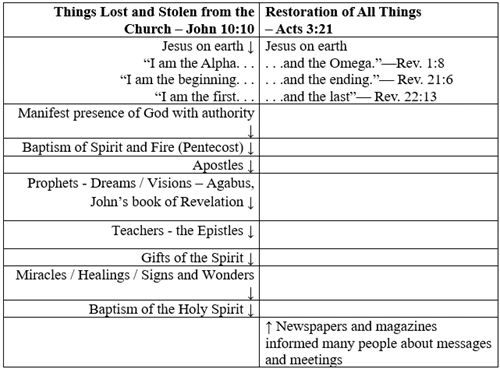
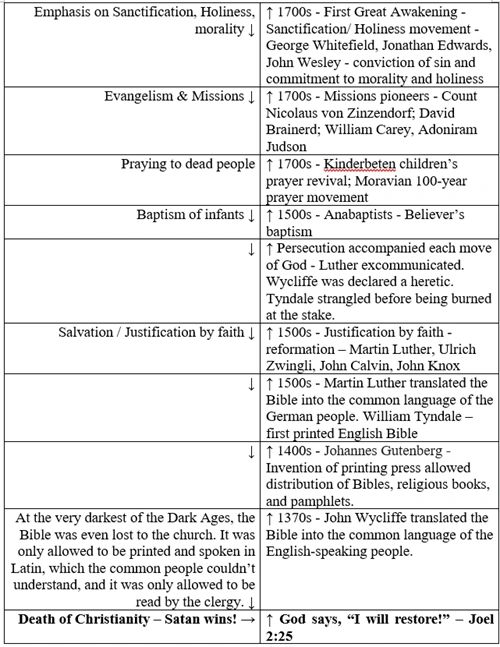
The chart below begins on the left side with Jesus on earth at the beginning of the Church Age. You can follow the left column downward to see all that the Church lost over the years since then. The right side of the chart begins at the bottom with God’s promise to restore what was lost. You can follow the right column upward to follow the restoration of all things until Jesus is back on earth again at the end of the Church Age.
References:
Anonymous. „Gründliche Nachrichten Von derer Evangelischen Schlesier Kinder Andacht/ Oder Denen/von denen Kindern in Schlesien/unter freyem Himmel/auf offenem Felde gehaltenen Bet=Stunden.“ (AFSt 121 A17). 2-4.
The Great Awakening: Origin, Key Figures and Influence. Christianity.com. (n.d.). https://www.christianity.com/church/church-history/timeline/1701-1800/the-great-awakening-11630212.html
John Wesley’s Impact and Significance in America. Christianity.com. (n.d.-a). https://www.christianity.com/church/church-history/john-wesleys-big-impact-on-america-11630220.html
Romon, P. (n.d.). John Wesley and the History of Methodism. Mapping the Great Awakening. https://people.smu.edu/mappingthega/stories/s15/
Swensson, E. J. (2010). Kinderbeten: The Origin, Unfolding, and Interpretations of the Silesian Children’s Prayer Revival. Wipf & Stock.
Swensson, E. J. (2014, November 17). The Petersens and the Silesian Kinderbeten Revival. Academia.edu. https://www.academia.edu/9367098/The_Petersens_and_the_Silesian_Kinderbeten_Revival
Wikimedia Foundation. (2024, February 22). History of Newspaper Publishing. Wikipedia. https://en.wikipedia.org/wiki/History_of_newspaper_publishing