Three Transforming Experiences - Part 21
In Moses’ Tabernacle and also in Solomon’s Temple, fire was sent from God, and the glorious presence of God filled the Tabernacle and the Temple. The same experience is available to each of us as living temples of God.
But the fire of God did not come to the Tabernacle of Moses or to the Temple of Solomon until the sacrifices were laid down on the altar as God had specified. The Apostle Paul exhorted us to present our bodies as living sacrifices to God (Romans 12:1).
After I realized this, I made a decision to follow the instructions that God had given for burnt offerings in Leviticus chapter 1, and to use them as guidelines for presenting myself to God as a living sacrifice.
After my very first day of doing this, I had an unusual experience.
I should tell you that for many years I have had an audio Bible playing in my home night and day with only occasional interruptions. The reason I do this is because Jesus told us that, “the words that I speak unto you, they are spirit, and they are life” (John 6:33 KJV). If it is true that the very words of Jesus are life itself, then I want God’s words to be spoken in my home all the time, night and day.
I used to play audio Bible CDs night and day, but I wore out two CD players doing that. What I do now is load the audio Bible mp3 files onto an old laptop computer that is too slow to be much good for anything else, and I set up the computer to play the files one after the other, in a loop. So the computer plays the audio files from Genesis to Revelation until the entire Bible is spoken, and then it starts over and continues. The Bible is spoken in my home through the night, but I turn the volume down low enough so that it does not disturb my sleep.
The night after I had followed the instructions for burnt offerings in Leviticus chapter 1, presenting myself as a living sacrifice to God, I was awakened at 3:11 in the morning by the audio Bible. The sound volume had stayed at its normal low level throughout the night until the words of Leviticus chapter 1 began to be spoken. When the first word of that chapter was spoken, the sound increased to a booming volume that woke me up suddenly. The volume was so loud that I was a bit concerned that it might be disturbing the neighbors. The entire chapter was spoken at that booming volume. Then, when the chapter was finished, the volume returned to the normal low level.
I couldn’t find any natural explanation for what had just happened. I am convinced that it was supernatural. I believe that God caused this chapter to be spoken at a booming volume to confirm that I was on the right track, and that following the instructions given in Leviticus chapter 1 was an important key for leading us into the Baptism of Fire that would prepare us for the Feast of Tabernacles experience of Transfiguration.
Laying Yourself on the Altar
Here are the steps that I use on a regular basis to lay my life down on the altar as a living sacrifice to God, following the instructions that God specified in Leviticus chapter 1.
1. Realize that the animal dies in my place.
We must first understand that the animal spoken of in Leviticus chapter 1 is taking our place on the altar. So, whatever is done to the animal during the process of making the burnt offering is a physical representation of what we must do spiritually, mentally, and emotionally to present ourselves as living sacrifices to God in the way that satisfies Him.
Just as the animal lost his life as a sacrifice to God, we are called to lay down our lives. This is a conscious decision. It is a serious commitment.
“Whoever desires to come after Me, let him deny himself, and take up his cross, and follow Me. For whoever desires to save his life will lose it, but whoever loses his life for My sake and the gospel’s will save it.”—Mark 8:35 (NKJV)
To confirm this, I would say something like, “God, I voluntarily lay my life down as a living sacrifice to you and to your service. My life is yours. My life is no longer my own.”
2. Blood is sprinkled on the altar.
Blood is the life of the animal.
“For the life of the flesh is in the blood”—Leviticus 17:11 (NKJV)
When the blood is sprinkled on the altar, this gives evidence that the sacrifice has truly been made. This step is the requirement of evidence that the life is sacrificed. There must be evidence in our lives of our sincerity. If we truly lay down our lives for Jesus, our lives will prove it. When we truly become living sacrifices to God, it will be like sprinkling our blood on the altar daily.
To confirm this, I would say something like, “May every action, every word, every motive, every attitude, every thought of mine give evidence that my life is no longer my own, but I live each moment as a living sacrifice to you, giving my life in your service.”
3. The animal is skinned and cut into pieces.
Removing the skin takes this experience deeper than just dealing with surface issues. Cutting the animal into pieces shows that each major area of our lives is consciously laid on the altar. Dealing with each major area of our lives separately gives us an opportunity to be more focused in our consecration to the Lord.
To enter into this deeper consecration, I would say something like, “Lord, I consciously and intentionally lay down every area of my life, giving each area to you with no reservations.”
Then I would thoughtfully name every major area of my life and lay each one on the altar individually.
“I lay down all of my activities, my future, my relationships, my health, my work, my finances and all of my possessions … I give you complete ownership and control of my time and my energy.”
“Therefore humble yourselves under the mighty hand of God [set aside self-righteous pride], so that He may exalt you [to a place of honor in His service] at the appropriate time, casting all your cares [all your anxieties, all your worries, and all your concerns, once and for all] on Him, for He cares about you [with deepest affection, and watches over you very carefully].”—1 Peter 5:6-7 (AMP)
4. Focused attention is given to the head.
The head is laid on the altar separately and intentionally.
Laying our heads on the altar involves focused surrender of our thoughts, our opinions, our eyes, ears, and the words of our mouths.
To accomplish this, I would say something like, “Lord, I give you everything in my head. I no longer have any rights to my own opinions. I want to lay down my opinions and exchange them for Your Truth. I give You the rights to my thoughts. As You enable me to do so, I choose to follow your instructions, ‘Casting down imaginations, and every high thing that exalteth itself against the knowledge of God, and bringing into captivity every thought to the obedience of Christ’ (2 Corinthians 10:5 KJV).”
“Enable me to pass every thought through the filters that you gave us in Philippians 4:8, so that I only dwell on ‘whatever things are true, whatever things are noble, whatever things are just, whatever things are pure, whatever things are lovely, whatever things are of good report, if there is any virtue and if there is anything praiseworthy—meditate on these things.’ (NKJV).”
“Enable me to guard my mouth so that I only speak words that are pleasing to You with no unnecessary offense to You or to anyone else. Make me a living example of James 3:2, which declares that ‘If any man offend not in word, the same is a perfect man, and able also to bridle the whole body’ (KJV).”
“May the words of my mouth and the meditation of my heart be pleasing to you, O Lord, my rock and my redeemer” (Psalm 19:14 NLT).
“Set a watch on my ears and on my eyes so that I do not listen to anything that displeases You or watch anything that displeases You.”
“Enable me to obey Psalm 101:3, which declares that ‘I will set no worthless or wicked thing before my eyes’ (AMP). Enable me to be in the company of the blessed ones described in Psalm 1:1-2:”
“Blessed (happy, fortunate, prosperous, and enviable) is the man who walks and lives not in the counsel of the ungodly [following their advice, their plans and purposes], nor stands [submissive and inactive] in the path where sinners walk, nor sits down [to relax and rest] where the scornful [and the mockers] gather.” (AMPC)
5. Focused attention is given to fat.
When the Bible refers to fat here, it refers to areas of strength or abundance in our lives. This includes our talents, gifts, and areas where we feel most self-confident. These are strengths, talents, and areas of abundance that might tend to lead us to depend more on ourselves and less on God.
It is important to give focused attention to laying these areas of strength and abundance on the altar in order to declare that our dependence is on God and not on ourselves.
To accomplish this, I might say something like, “Lord I lay down my talents, my gifts, and every area of my life in which I feel strong and confident. I do not depend on myself or on anything that I have, but I depend on you. My security and my confidence is not in myself and my talents or anything that I have, but my security and my confidence is in You and You alone. I consecrate my gifts, my talents, and every area of abundance in my file to You. These are Yours to be used in Your service to glorify You, Lord Jesus.”
I would name every area of strength, talent, and abundance in my life, laying them all down on the altar.
6. Internal organs and legs must be first washed with water.
Internal organs speak of our heart motivations, our will, and our emotions. Legs speak of our daily walk.
These are presented to God and laid down on the altar along with everything else, but these must be washed with water in order to be acceptable to God. What this speaks of is “the washing of water with the word [of God]” from Ephesians 5:26. We are contaminated to the extent that we have internalized the values of the world and the deceptions of evil influences. Our own natural appetites, if they are not submitted to the will of God as described in the Scriptures, can also lead us in wrong directions.
To bring our internal organs and our legs into agreement with God, and make them acceptable to be presented to God on His altar, we must wash them in the water of His Word through daily meditation on the Scriptures.
To declare my agreement with this, I might say something like, “God enable me to live a lifestyle of meditating on your Word day and night. Remind me and prompt me daily to think on the Truth of Your Word. Transform my soul through meditation on Your Word, as Paul exhorted us in Romans 12:2:”
”Do not be conformed to this world, but continuously be transformed by the renewing of your minds so that you may be able to determine what God’s will is—what is proper, pleasing, and perfect.” (ISV)
“Enable me to obey the instruction of James 1:21, that says, ‘Therefore lay aside all filthiness and overflow of wickedness, and receive with meekness the implanted word, which is able to save your souls.’” (NKJV)
“Let Your Word truly be ‘a lamp to my feet And a light to my path’ as in Psalm 119:105.”
“Making a commitment to wash my soul daily in the water of Your Word, I lay down my will, my emotions, my heart motivations, my plans, my goals, my ambitions, my daily walk, giving them all to you with no restrictions and no reservations.”
7. God sends the Fire
As we are faithful to lay down our lives on God’s altar as living sacrifices, God will be faithful to do His part to send the fire to receive our sacrifices, but just as in the dedication of Solomon’s temple, the fire may not come with the first sacrifice. Many animals were sacrificed on the altar before the fire came to Solomon’s Temple.
We should not look at this as a one-time act. As Paul said, “I die daily” (1 Corinthians 15:31). This needs to be a regular practice. Consecration of our lives to the Lord should be done intentionally on a regular basis.
When God gave instructions to His people about how the Feast of Tabernacles should be observed, He specified that burnt offerings should be presented to Him each day.
“For seven days you will bring an offering made by fire to the Lord. There will be a holy meeting on the seventh day. And on that day you must not do any regular work.”—Leviticus 23:8 (ICB)
The rivers of living water that flow out of the tabernacle in Ezekiel 47 are a prophetic picture of the end-time fulfillment of the Feast of Tabernacles. But the outflow of those living waters is preceded by daily burnt offerings in Ezekiel 46.
“Every morning you will give a year-old lamb that has nothing wrong with it. It will be for a burnt offering to the Lord every day.”—Ezekiel 46:13 (ICB)
Every animal that was offered as a burnt offering was required to be flawless. There could be no defects at all. As each of us commits to present ourselves as a living sacrifice to God, He will examine our sacrifice to see if it is sincere and complete with nothing held back. If God finds flaws in our sacrifice because we are holding something back or not offering Him our very best, He will bring conviction through His Holy Spirit to prompt us to correct those parts of our sacrifice until it is entirely pleasing to Him.
When God is satisfied that our “all” is on the altar, He will send the fire that will purge us of any uncleanness or evil influence that might be lingering in us. This will prepare us to receive His glorious, manifested presence that will come to fill His temples (our bodies).
Introducing his book, Thrones of Our Soul, Paul Keith Davis said, “Now here’s the thing. When you have fully yielded your soul to God in every department of our existence, then you will have entered into the union experience when the Lord comes into you and takes up residence. Kathryn Kuhlman had that experience. Do you remember? If you’ve ever watched the videos of her where she said ‘I can take you to the spot where Kathryn Kuhlman died.’ She is saying ‘I can take you to the spot where everything was yanked up out of my soul, and the Lord took up residence on every throne of my existence.’ That’s what it means, ‘dying to self.’” (Davis)
God gave His people three great feasts—Passover, Pentecost, and Tabernacles. The Church has experienced literal fulfillment of the Passover and Pentecost experiences, and the Church will also experience the reality of the Feast of Tabernacles.
These experiences are not just available for the entire Church at specific moments in history. These are available now to every individual. Each of us can experience our own Passover (Salvation), Pentecost (Baptism of the Holy Spirit), and Tabernacles (Transfiguration) when the fire comes down, consumes us and His glorious presence fills us just as it filled the Temple in Solomon’s time.
In order to qualify to participate in the Feast of Tabernacles experience of Transfiguration, we must satisfy God’s requirements of humility, an intimate relationship with God, and complete consecration of our lives to the Lord that prepares us to receive the Baptism of Fire.
“But we have this treasure in clay jars to show that its extraordinary power comes from God and not from us. In every way we’re troubled but not crushed, frustrated but not in despair, persecuted but not abandoned, struck down but not destroyed. We are always carrying around the death of Jesus in our bodies, so that the life of Jesus may be clearly shown in our bodies. While we are alive, we are constantly being handed over to death for Jesus’ sake, so that the life of Jesus may be clearly shown in our mortal bodies. And so death is at work in us, but life is at work in you.”—2 Corinthians 4:7-12 (ISV)
In his journal, the young Welsh revivalist Evan Roberts wrote, “I have made my sacrifice. I have laid the wood on the altar. Now I only wait for God to send the fire.” It was shortly after this that the Welsh revival broke out in 1904, which profoundly impacted the Azusa Street revival two years later and changed the world and the Church forever. (Adams)
**“**And all who have this eager expectation will keep themselves pure, just as he is pure.”—1 John 3:3 (NLT)
**P.S. **
Just as I was finishing this final chapter of The Three Transforming Experiences, I happened on this Facebook post from Paul Keith Davis that he shared earlier this week on December 27, 2021:
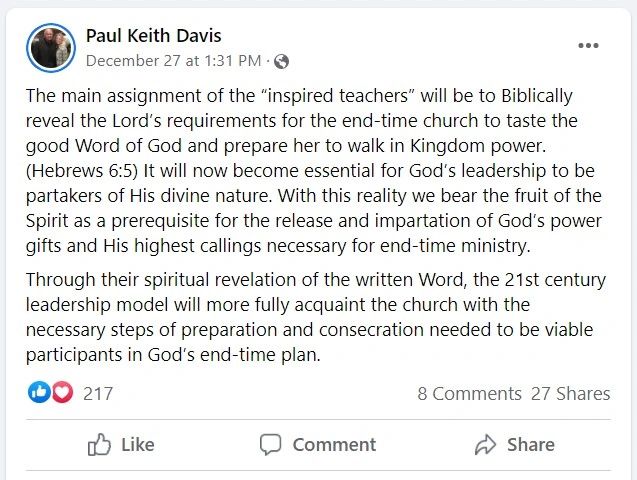
My prayer is that this will be one of those inspired messages that will help you prepare to fully participate in God’s end-time plan.
References:
Adams, Kevin (2017). A Diary of Revival - The Story of the 1904 Welsh Awakening. Vision Video. Retrieved from https://vimeo.com/ondemand/adiaryofrevival/134298104.
Davis, Paul Keith (n.d.). Session 3A. Engaging Heaven School of Prophetic. WhiteDove Ministries.
Three Transforming Experiences
Watch the video:
Download the Microsoft PowerPoint file: