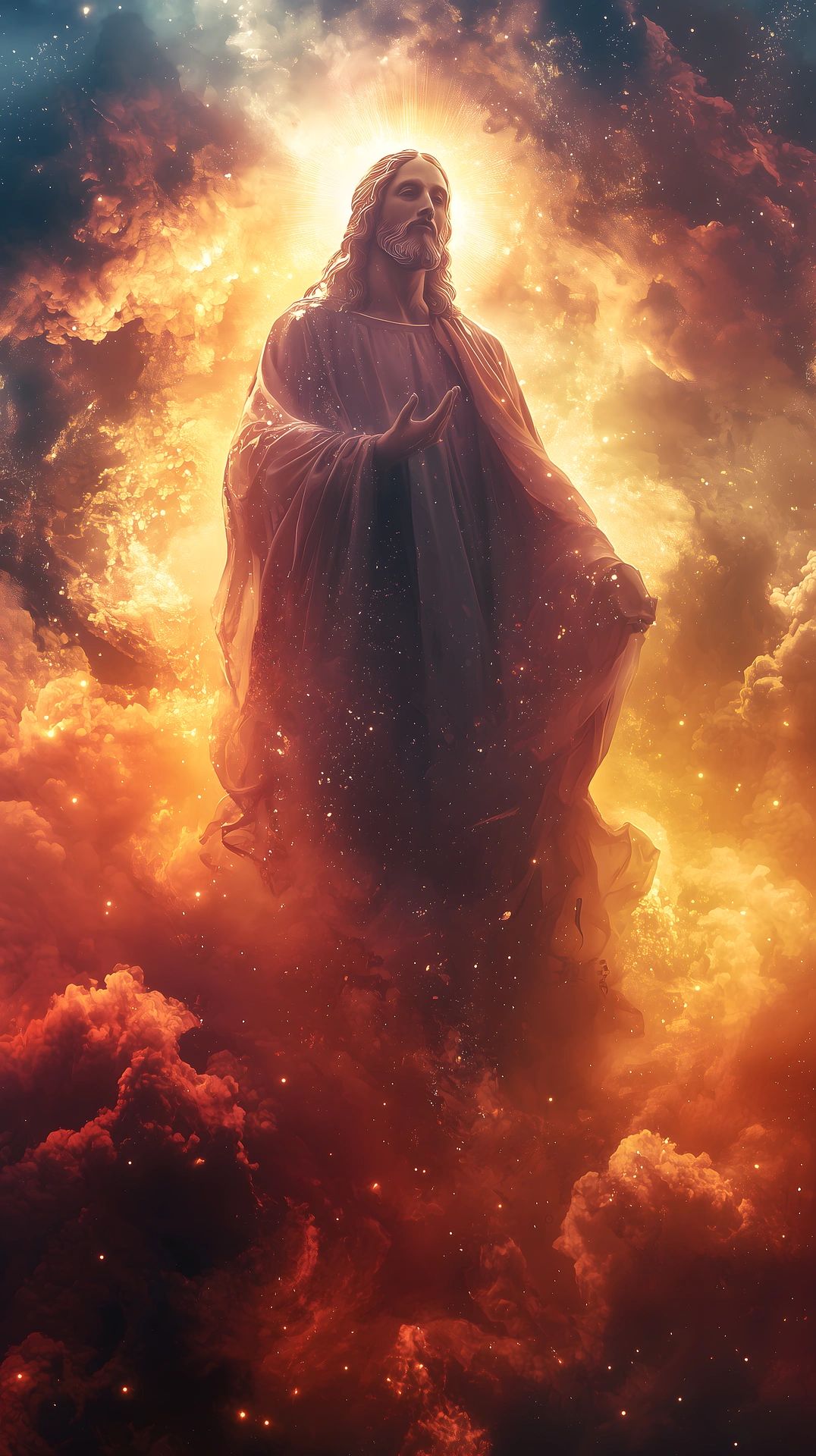
A Deeper Dive Into the Book of Revelation - Part 52
Four times in the book of Revelation, Jesus called Himself Alpha and Omega.
“I am Alpha and Omega, the beginning and the end, the first and the last.”—Revelation 22:13 (KJV)
The Church age began with the coming of “Alpha Jesus.” The Church age will end with the coming of “Omega Jesus.” Jesus is always the same, yesterday, today and forever, but he will look very different at His second coming than He did at His first coming, and He will be coming to accomplish very different purposes the second time then He did the first time.
In the first chapter of Revelation, John was given a glimpse of Jesus as He will appear at the end of the Church age, and the awesomeness of Jesus’ presence completely overwhelmed John.
“and in the midst of the seven lampstands One like the Son of Man, clothed with a garment down to the feet and girded about the chest with a golden band.”—Revelation 1:13 (NKJV)
John was very familiar with Jesus’ appearance. He had walked with Jesus during his earthly ministry as one of the Lord’s three closest friends, along with Peter and James.
But even though John recognized the person he was seeing, this manifestation of Jesus was far more glorious and awesome than the “Alpha Jesus” that John had walked with for years on earth.
Coming as the Judge
Jesus appears completely clothed with a garment. Being fully clothed may represent righteousness and preparation for the role that He was to fulfill in these last days.
The golden band around His chest is significant. The priests wore girdles, or bands, around their waists. But, as William Branham pointed out, Jesus is not coming the second time as the Priest, but as the Judge. (Branham, p.53)
The only other time we see golden sashes or girdles worn around the chests is in Revelation 15 when the seven angels come out of the temple to pour out the seven last plagues of God’s wrath upon the earth.
“And the seven angels came out of the temple, having the seven plagues, clothed in pure and white linen, and having their breasts girded with golden girdles.”—Revelation 15:6 (NKJV)
The Sevenfold Glory of His Person
Then John describes what William Branham called “the sevenfold glory of His person.”
“His head and hair were white like wool, as white as snow, and His eyes like a flame of fire; His feet were like fine brass, as if refined in a furnace, and His voice as the sound of many waters; He had in His right hand seven stars, out of His mouth went a sharp two-edged sword, and His countenance was like the sun shining in its strength.”—Revelation 1:14-16 (NKJV)
1. “His head and hair were white like wool, as white as snow”
Jesus’ white head and hair may represent mature wisdom and judicial authority.
John’s vision is very similar to the vision that Daniel saw of the Lord as the end-time judge of the earth:
“I beheld till the thrones were cast down, and the Ancient of days did sit, whose garment was white as snow, and the hair of his head like the pure wool: his throne was like the fiery flame, and his wheels as burning fire.
“A fiery stream issued and came forth from before him: thousand thousands ministered unto him, and ten thousand times ten thousand stood before him: the judgment was set, and the books were opened.”—Daniel 7:9-10 (NKJV)
2. “His eyes like a flame of fire”
In Scripture, God is described as three things: God is love; God is light; and God is a consuming fire.
In His first coming, Jesus came as the embodiment of pure love, and He declared Himself to be the Light of the world in the Gospel of John.
But in His second coming, Jesus comes as a consuming fire to execute judgment upon the earth.
Later in his experience, John again sees His eyes as flame of fire as Jesus returns to administer the wrath of God in Revelation 19:11-16:
“Now I saw heaven opened, and behold, a white horse. And He who sat on him was called Faithful and True, and in righteousness He judges and makes war. His eyes were like a flame of fire, and on His head were many crowns. He had a name written that no one knew except Himself. He was clothed with a robe dipped in blood, and His name is called The Word of God. And the armies in heaven, clothed in fine linen, white and clean, followed Him on white horses. Now out of His mouth goes a sharp sword, that with it He should strike the nations. And He Himself will rule them with a rod of iron. He Himself treads the winepress of the fierceness and wrath of Almighty God. And He has on His robe and on His thigh a name written: KING OF KINGS AND LORD OF LORDS.” (NKJV)
3. “His feet were like fine brass, as if refined in a furnace”
Brass also represents judgment for sin.
Furniture in the Outer Court of the Tabernacle of Moses was made of brass because sin was dealt with in the Outer Court. The altar was made of brass and the laver was made of brass. But after a priest passed into the Inner Court of the Holy Place and the Holy of Holies, the furniture there was gold. There was no more brass because sin had already been dealt with in the Outer Court.
In Numbers chapter 21, when the people of Israel were suffering from a plague of judgment for their sins, Moses made a serpent of brass and set it on a pole. Anyone who looked to the serpent would be spared from the judgment of sin. This is a picture of Jesus who would be hung on a cross and made sin for us so that we could be made the righteousness of God in Christ (2 Corinthians 5:21).
When Jesus walked the earth at the beginning of the Church age, His feet were shod with the preparation of the Gospel of peace, but when He returns, His feet will be like brass as He administers the judgment and wrath of God upon earth.
4. “His voice as the sound of many waters”
Ezekiel heard this voice many years before, as he beheld the glory of the Lord:
“And behold, the glory of the God of Israel came from the way of the east. His voice was like the sound of many waters; and the earth shone with His glory.”—Ezekiel 43:2 (NKJV)
William Branham helps us understand the symbolism of many waters:
“Now what do the waters represent? Hear it in Revelation 17:15, ‘The waters which thou sawest, … are peoples, and multitudes, and nations, and tongues.’ His voice was as the sound of multitudes speaking. What is it? It is the judgment. For these are the voices of the multitudes of witnesses, who by the Holy Spirit all through the ages have testified to Christ and preached His Gospel. It will be the voice of every man rising in judgment against the sinner who would not take warning. The voices of the seven messengers will be heard loud and clear. Those faithful preachers who preached the saving power of Jesus, who preached water baptism in Jesus’ Name, who preached the infilling and power of the Holy Ghost, who stood with the Word more than they stood with their own lives; all of them were the voice of Jesus Christ by the Holy Ghost down through the ages.” (Branham, p.57)
Branham’s explanation is borne out by Scripture. John hears a voice like the sound of many waters again later, but this time, it is not Jesus’ voice. It is the voice of a multitude of people.
“Then I heard something like the voice of a great multitude and like the sound of many waters, and like the sound of mighty peals of thunder, saying, ‘Hallelujah! For the Lord our God, the Almighty, reigns.’”—Revelation 19:6 (NASB)
5. “He had in His right hand seven stars”
As Jesus tells John in verse 20, “The seven stars are the angels of the seven churches.” But the word for “angels” in this verse literally means “a messenger; an envoy; one who is sent.” This often refers to angelic messengers, but in this context, that doesn’t seem to fit because in the next chapter, John is told to write to these “sent ones.” It wouldn’t make much sense for Jesus to tell John to write to angels. How could John send a written message to an angel?
Most likely, these “angels” are the pastors of these seven churches.
In this vision, John’s sees the reality of Jesus’s words in John 10:27-29:
“My sheep hear my voice, and I know them, and they follow me. I give them eternal life, and they will never perish, and no one will snatch them out of my hand. My Father, who has given them to me, is greater than all, and no one is able to snatch them out of the Father’s hand.” (ESV)
John’s vision also illustrates the truth of Proverbs 21:1:
“The king’s heart is in the hand of the Lord, as are the watercourses; He turns it whichever way He wills.” (AMPC)
The hearts of our leaders are in the hand of the Lord. He protects them and guides them according to His will.
This highlights the importance of always remembering our leaders in prayer, as Paul exhorts us:
“First of all, then, I admonish and urge that petitions, prayers, intercessions, and thanksgivings be offered on behalf of all men, For kings and all who are in positions of authority or high responsibility, that [outwardly] we may pass a quiet and undisturbed life [and inwardly] a peaceable one in all godliness and reverence and seriousness in every way.”—1 Timothy 2:1-2 (AMPC)
As we pray to God for our leaders, God can easily direct them to lead us in ways that are most beneficial for us and for our children because He holds the hearts of our leaders in His hand.
6. “out of His mouth went a sharp two-edged sword”
We know that the sword from the mouth of Jesus is the Word of God. The writer of Hebrews makes this connection for us:
“For the Word that God speaks is alive and full of power [making it active, operative, energizing, and effective];** it is sharper than any two-edged sword,** penetrating to the dividing line of the breath of life (soul) and [the immortal] spirit, and of joints and marrow [of the deepest parts of our nature], exposing and sifting and analyzing and judging the very thoughts and purposes of the heart.”—Hebrews 4:12 (AMPC)
When Jesus returns, the Word of God Itself will judge the people on earth.
“Whoever rejects Me and refuses to accept My teachings, has one who judges him; the very word that I spoke will judge and condemn him on the last day.”—John 12:48 (AMP)
“on that day when God, through Jesus the Messiah, will judge people’s secrets according to my gospel”—Romans 2:16 (ISV)
John actually saw this take place later as He watched Jesus return to earth to deal out the final wrath of Almighty God.
“From his mouth comes a sharp sword with which to strike down the nations, and he will rule them with a rod of iron. He will tread the winepress of the fury of the wrath of God the Almighty.”—Revelation 19:15 (ESV)
7. “His countenance was like the sun shining in its strength.”
This is the glory of God shining from the face of the Lord Himself.
When Moses returned to the camp of Israel after spending 40 days and nights in the presence of the Lord on Mount Sinai, his face also glowed with the glory of God.
“Moses came down from Mount Sinai. As he came down from the mountain with the two covenant tablets in his hand, Moses didn’t realize that the skin of his face shone brightly because he had been talking with God. When Aaron and all the Israelites saw the skin of Moses’ face shining brightly, they were afraid to come near him.”—Exodus 34:29-30 (CEB)
One of the main purposes of the Sun is to give light to the world. In the New Jerusalem, there will be no need for the Sun because the Lord Jesus, the Light of the World, will be give light to the city. His glory will illumine the city.
“And the city has no need of the sun nor of the moon to give light to it, for the glory (splendor, radiance) of God has illumined it, and the Lamb is its lamp and light.”—Revelation 21:23 (AMP)
Peter, James, and John witnessed a preview of this on the Mount of Transfiguration.
“And His appearance changed dramatically in their presence; and His face shone [with heavenly glory, clear and bright] like the sun, and His clothing became as white as light.”—Matthew 17:2 (AMP)
In Revelation chapter 10, we see a very powerful angel with great authority. Some people believe this mighty angel is the Lord Jesus Himself, but whether he is or not, this angel certainly carries the glory of God.
“I saw another strong angel coming down from heaven, clothed with a cloud; and the rainbow was on his head, and his face was like the sun, and his feet like pillars of fire”—Revelation 10:1 (NASB)
This is the vision of Jesus that John saw on the Isle of Patmos. This is the Jesus that will shortly return to earth as the King of Kings and Lord of Lords to administer the judgment and wrath of God upon the earth. When John saw Jesus in this form, there was no more strength in his body to stand. He collapsed at Jesus’ feet.
**Reference: **
Branham, W. M. (2005). An Exposition of the Seven Church Ages. Voice of God Recordings. (PDF)
Davis, P. K. (2016, January 20). Webinar 54 “The Sevenfold Revelation” by Paul Keith Davis. YouTube. https://www.youtube.com/watch?v=X9CgQEVnhiY