Simple Keys to Understanding the Book of Revelation — Part 7
We’ve looked at the resurrection of the dead, but what about the living? What about those of us who will still be alive at the end of this age? What will happen to us?
Many people believe that the “whole Church” will be raptured out of this world and caught up to Heaven before the Tribulation. Others believe that the “whole Church” will go through the Tribulation. These views cause people to be confused when they try to understand the book of Revelation because they see groups of believers in different chapters of the book and assume that each group is the “whole Church,” sometimes being caught up to Heaven and sometimes still on Earth during the Tribulation. As they read it, in one moment the Church is being raptured out of the Tribulation, and in the next moment, the Church is going through it. The whole book becomes totally confusing.
It is only when you realize that God deals with the Church as three distinct groups in the book of Revelation that you can begin to make sense of the book as you track the progress of each of the three groups. This is a major key to understanding the book of Revelation.
Let me explain.
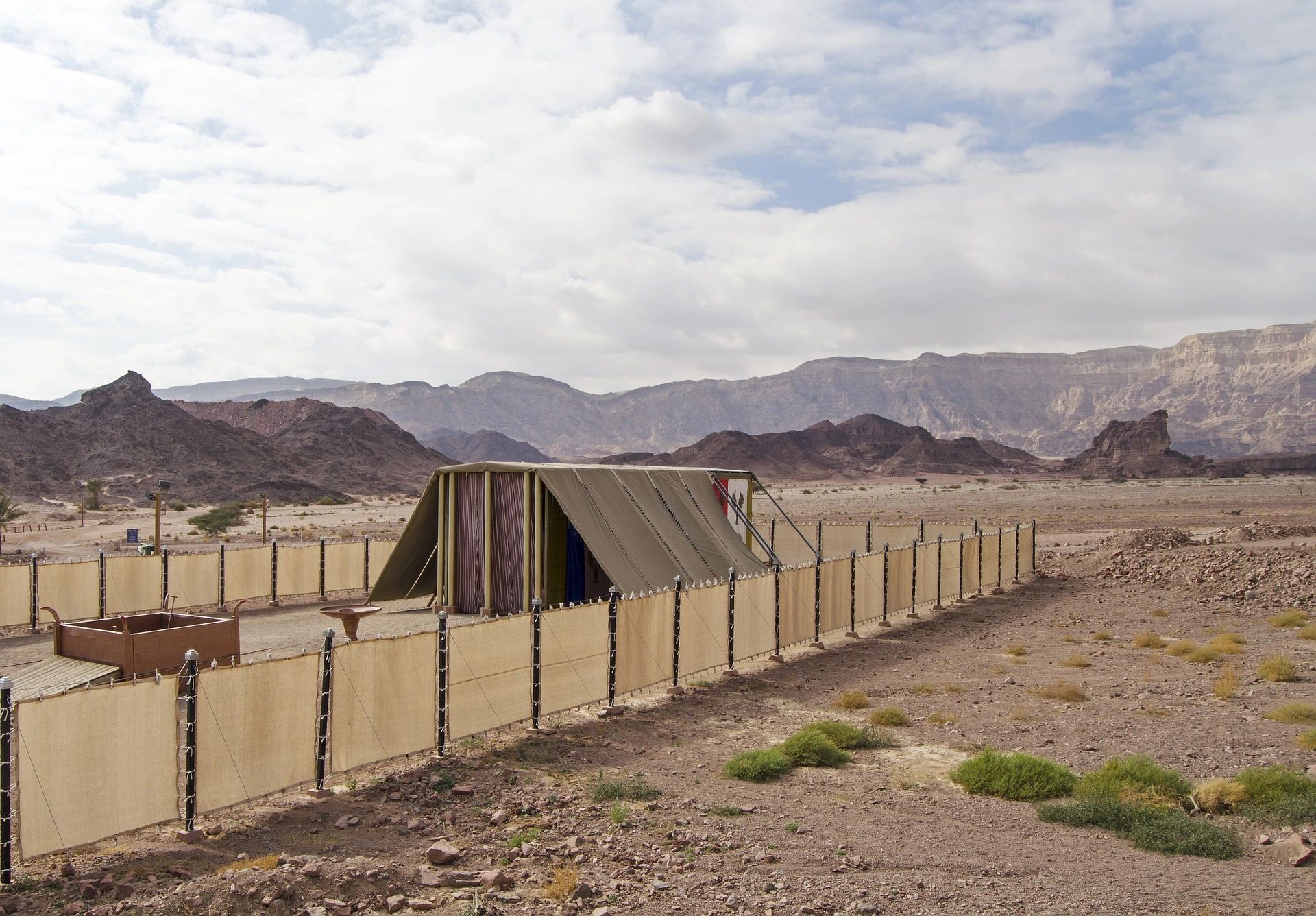
The Tabernacle
The three distinct groups of believers can be seen in Moses’ Tabernacle. The Tabernacle was divided into three areas:
- ** Outer Court**
- ** Holy Place**
- ** Holy of Holies, or The Most Holy Place**
The outer court had a fence of curtains around it with an entrance on the east side. There was no roof or covering of protection over the outer court. It was open to the weather. There were two pieces of furniture in the outer court, the bronze altar and the bronze laver. When a person entered the Tabernacle enclosure from the East, the first piece of furniture he encountered was the bronze altar. This represented salvation. It was where confession and sacrifices were made for sins.
Believers represented by the Outer Court never move much past salvation. They get to the brazen altar, but really have no desire to press in further to develop a relationship with God. That was the vast majority of the Israelites in Moses’ day, and it is the vast majority of believers today.
Some of these believers may go beyond salvation to experience sanctification, which is symbolized by the laver, which was a large brass washing bowl filled with water, but what is missing in the Outer Court is relationship with God. Outer-court believers never press in to the secret place of God to develop relationship with Him.
A smaller number of believers press on into the Holy Place and begin to develop relationships with God. In the Holy Place, there were three pieces of furniture: the Table of Shewbread, symbolizing the Word of God, the Golden Lampstand symbolizing the illumination of the Spirit of God, and the Altar of Incense, which represents worship and prayer. Only the priests—those who ministered to God—could enter the Holy Place. There was a covering over the Holy Place and the Holy of Holies, and it was completely enclosed so that people outside of these areas could not see into them. This was God’s secret place. It is spoken of in Psalm 91:1 (NKJV):
“He who dwells in the secret place of the Most High Shall abide under the shadow of the Almighty.”
Psalm 91 goes on to describe incredible protections that are given to those believers who abide in God’s secret place.
*“3 Surely He shall deliver you from the snare of the fowler And from the perilous pestilence. ****4 ****He shall cover you with His feathers, And under His wings you shall take refuge; His truth shall be your shield and buckler. ****5 ****You shall not be afraid of the terror by night, Nor of the arrow that flies by day, ****6 ***Nor of the pestilence that walks in darkness, Nor of the destruction that lays waste at noonday.
***7 ****A thousand may fall at your side, And ten thousand at your right hand; But it shall not come near you. ****8 ***Only with your eyes shall you look, And see the reward of the wicked.
9 Because you have made the Lord, who is my refuge,* Even the Most High, your dwelling place, ****10 ****No evil shall befall you, Nor shall any plague come near your dwelling; ****11 ****For He shall give His angels charge over you, To keep you in all your ways. ****12 ****In their hands they shall bear you up, Lest you dash your foot against a stone. ****13 ***You shall tread upon the lion and the cobra, The young lion and the serpent you shall trample underfoot.
14 “Because he has set his love upon Me,* therefore I will deliver him; I will set him on high, because he has known My name. ****15 ****He shall call upon Me, and I will answer him; I will be with him in trouble; I will deliver him and honor him. ****16 ***With long life I will satisfy him, And show him My salvation.”—Psalm 91:3-16 (NKJV)
But as verses 1, 9, and 14 tell us, these protections are only provided to those believers who press on beyond the salvation experience to develop a relationship with God, abiding in His secret place within the Holy Place and the Holy of Holies. Those who never venture beyond the Outer Court do not experience the same blessings of protection. This becomes very significant during the Great Tribulation.
The Holy of Holies had a thick veil separating it from the Holy Place. There were only two pieces of furniture in the Holy of Holies. There was the Ark of the Covenant and the Mercy Seat which covered the Ark. On the Mercy Seat were images of two cherubim that were facing each other with wings extended. This was the most sacred space of all because God said,
“And there I will meet with you, and I will speak with you from above the mercy seat, from between the two cherubim which are on the ark of the Testimony”—Exodus 25:22 (NKJV)
The Holy of Holies represents those believers who could not be satisfied by the Outer Court or the Holy Place. They are satisfied by nothing less than the abiding presence of God. These are the Overcomers that Jesus spoke of in Revelation chapters 2 and 3. These are the ones for whom Moses set up his own tent of meeting outside the camp. These are like Joshua who stayed in the tent, even after Moses left, abiding in the presence of God in a space where God spoke to people face to face in intimate relationships.
“Now Moses used to take his own tent and pitch it outside the camp, far away from the camp, and he called it the tent of meeting [of God with His own people]. And everyone who sought the Lord would go out to the [temporary] tent of meeting which was outside the camp. Whenever Moses went out to the tent, all the people would rise and stand, each at his tent door, and look at Moses until he entered the tent. Whenever Moses entered the tent, the pillar of cloud would descend and stand at the doorway of the tent; and the Lord would speak with Moses. When all the people saw the pillar of cloud standing at the tent door, all the people would rise and worship, each at his tent door. And so the Lord used to speak to Moses face to face, just as a man speaks to his friend. When Moses returned to the camp, his attendant Joshua, the son of Nun, a young man, would not depart from the tent.”—Exodus 33:7-11 (AMP)
These are the ones that Jesus calls His friends because everything that God tells Him, he passes along to them.
“I do not call you servants any longer, for the servant does not know what his master is doing; but I have called you [My] friends, because I have revealed to you everything that I have heard from My Father.”—John 15:15 (AMP)
But most believers never venture beyond the outer court.
Even those who press on into the Holy Place can fall short of God’s perfect will for them. God is seeking intimate relationship with us. Relationship is more important than ministry. There is a lot of ministry that is required to keep the Holy Place running smoothly. Bread must be replaced often for the Table of Shewbread. The wicks of the lampstand had to be constantly trimmed. Oil had to be made of pressed olives and replenished often to supply the lampstand. The supply of incense had to be monitored and replenished often.
Those believers who venture into the Holy Place can make their Christianity all about ministry. But God wants relationship.
Do you remember what Jesus said to Martha?
“Martha was worried about all that had to be done. Finally, she went to Jesus and said, ‘Lord, doesn’t it bother you that my sister has left me to do all the work by myself? Tell her to come and help me!’
“The Lord answered, ‘Martha, Martha! You are worried and upset about so many things, but only one thing is necessary. Mary has chosen what is best, and it will not be taken away from her.’”—Luke 10:40-42 (CEV)
In the parable of the ten virgins, the Lord again emphasizes the critical importance of maintaining a close relationship with Him in the final days of this age.
“Then the kingdom of heaven will be like ten virgins, who took their lamps and went to meet the bridegroom.*** Five of them were foolish [thoughtless, silly, and careless], and five were wise [far-sighted, practical, and sensible]. For when the foolish took their lamps, they did not take any [extra] oil with them, but the wise took flasks of oil along with their lamps. Now while the bridegroom was delayed, they all began to nod off, and they fell asleep. But at midnight there was a shout, ‘Look! The bridegroom [is coming]! Go out to meet him.’ Then all those virgins got up and put their own lamps in order [trimmed the wicks and added oil and lit them]. But the foolish virgins said to the wise, ‘Give us some of your oil, because our lamps are going out.’ But the wise replied, ‘No, otherwise there will not be enough for us and for you, too; go instead to the dealers and buy oil for yourselves.’ But while they were going away to buy oil, the bridegroom came, and those who were ready went in with him to the wedding feast; and the door was shut and locked. Later the others also came, and said, ‘Lord, Lord, open [the door] for us.’ ****But He replied, ****‘I assure you and most solemnly say to you, I do not know you [we have no relationship].’ ****Therefore, be on the alert [be prepared and ready], for you do not know the day nor the hour [when the Son of Man will come].”—Matthew 25:1-13 (AMP) *
You must move beyond the Outer Court to develop an intimate relationship with the Lord, abiding in His secret place. Your destiny in these last days depends on it!