What to Expect on Your Journey with God – Part 6
It is very common for us to experience emotional and spiritual “valleys” or “lows” after exhilarating and encouraging “mountaintop highs.” There are several examples of this in Scripture.
Jesus was welcomed into Jerusalem with a large crowd shouting “Hosanna!” “Blessed is he who comes in the name of the Lord!” “Blessed is the king of Israel!” (John 12:13 NIV). But, less than a week later, everything changed, and He was betrayed and crucified.
Elijah won a great victory over the prophets of Baal as God sent fire down from Heaven in a miraculous display on Mount Carmel. Only a few days later, Elijah was alone and running for his life from Jezebel, who had threatened to kill him. He sank into such a low emotional state that he asked God to take his life! (See 1 Kings 19.)
Abram experienced this same kind of “low” after the Lord appeared to him and gave him a very encouraging personal promise in Genesis 12:7.
Leaving that place of excitement, exhilaration, and encouragement, Abram “journeyed on, continuing toward the Negev (the South country of Judah)” (Genesis 12:9 AMP).
“Negev” means “dry, parched” land with “undulating, rolling hills.” This suggests that Abram is entering a “dry” period, without the encouraging circumstances he had previously experienced. It may feel like an emotional rollercoaster, going from a mountaintop high to a very low valley.
Many of us have gone through these times when it seems like God is silent, and we wonder if He has abandoned us. Everything has changed. Things are not working out for us as they did before, and we may wonder if we did something wrong to cause God to leave us.
None of that is true! Our emotions may be going wild trying to figure out where we went wrong, but the truth is that this is a normal part of the Christian life.
Abram was entering into a time of testing to see if he would be faithful to God, even in tough times. We will see that God had not abandoned him at all! God was guiding him and providing for him all the time!
It is the same for us! In those times when we may feel very alone and abandoned, God is just as close to us as He ever was! He has not gone anywhere! His guidance and provision are constant.
“Our faith may fail, his never wanes—That’s who he is, he cannot change!”—2 Timothy 2:13 (ISV)
God has said, “I will never leave you; I will never abandon you.” Deuteronomy 31:6—Hebrews 13:5 (ICB)
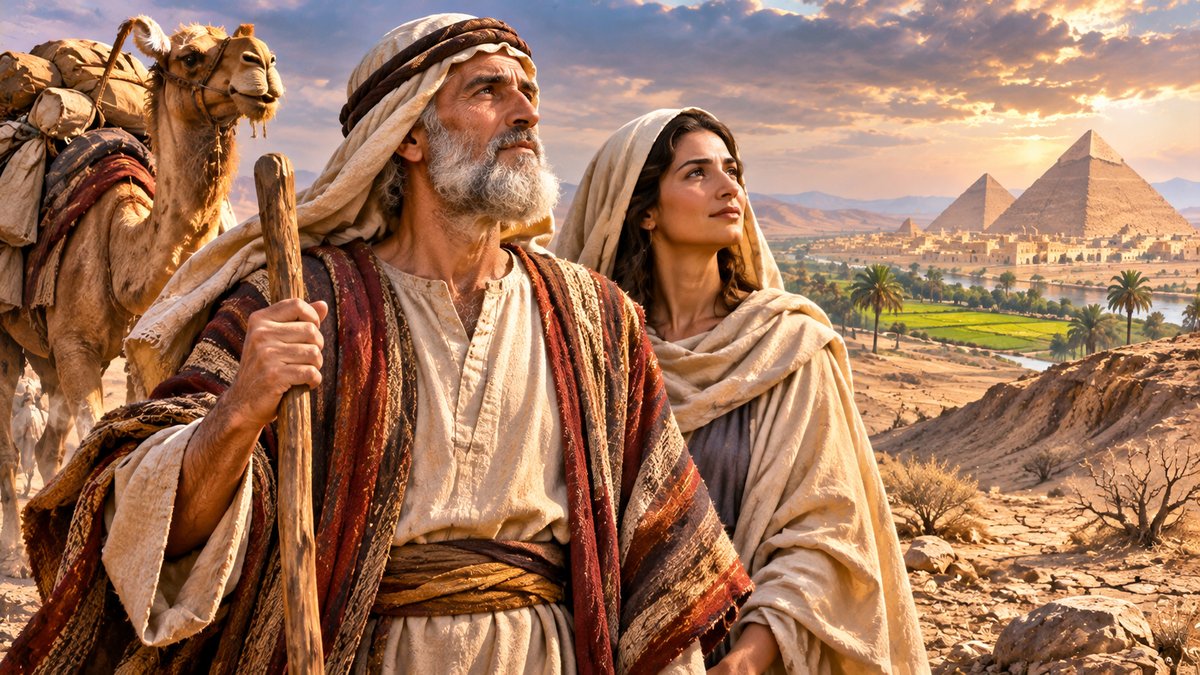
Going Down to Egypt
“Now there was a famine in the land; and Abram went down into Egypt to live temporarily, for the famine in the land was oppressive and severe.”—Genesis 12:10 (AMP)
Abram has not been following the Lord for very long, and after some very encouraging experiences, the circumstances of his life suddenly change. Abram experiences a time when things are scarce. He is concerned that his needs may not be met in the land into which God has led him.
So, Abram falls back into his old ways of thinking. Symbolically, this is represented by him going “down into Egypt to live temporarily.” In Scripture, when someone travels outside of the land God called them to, they go “down.” They go “down” into Egypt, or Moab, or some other place that is populated by people who don’t know God.
This can happen to any of us when we are under financial pressure, bills are piling up, and we don’t know if we will be able to put food on the table for ourselves and our families.
We may feel even more pressure to do something if God is silent to us. Sometimes, we may experience famines in which we can’t seem to connect with God.
“Look! The days are coming,” declares the Lord God, “when I will send a famine throughout the land—not a famine of food or a thirst for water—but rather a famine of hearing the words of the Lord.”—Amos 8:11 (ISV)
Although God never leaves or forsakes us, we may doubt His ability to care for us in times of great need. We may feel pressured into doing things that we wouldn’t normally do in order to get our needs met.
“Going down into Egypt” symbolizes Abram choosing to go the way of the world and leaving the path of God. This happens to us when we doubt that God will care for us and we resort to the doing things the world’s way. God’s ways are higher than ours. His ways sometimes are very different from our natural inclinations. It takes time to learn God’s ways and to realize that His ways are always best.
Self-Protection
Going down to Egypt, Abram convinced his wife Sarai to deceive the people of Egypt into believing that she was only his brother; not his wife. He felt that this would help them to avoid problems. In doing this, Abram failed the test of virtue and resorted to the ways of the world; departing from the ways of God.
“And when he was about to enter Egypt, he said to Sarai his wife, ‘Listen: I know that you are a beautiful woman; so when the Egyptians see you, they will say, “This is his wife”; and they will kill me [to acquire you], but they will let you live. Please tell them that you are my sister so that things will go well for me for your sake, and my life will be spared because of you.’”—Genesis 12:11-13 (AMP)
At first, this strategy seemed to work. Abram was treated well and increased his wealth … but it was going to destroy his family. Abram’s choices were going to lead his wife into a lifetime of sexual slavery.
“And when Abram came into Egypt, the Egyptians saw that the woman was very beautiful. The princes of Pharaoh also saw her and commended her to Pharaoh, and she was taken into Pharaoh’s house [harem]. And he treated Abram well for her sake; he acquired sheep, oxen, he-donkeys, menservants, maidservants, she-donkeys, and camels.”—Genesis 12:14-16 (AMPC)
God is Always Faithful
Abram may have walked away from God and gone back to the ways of the world, but God never left Abram. Even though Abram had failed this test of his character, God was still faithful to protect and provide for Abram. God intervened in a powerful way to save Abram and his wife Sarai.
“But the Lord punished Pharaoh and his household with severe plagues because of Sarai, Abram’s wife.
“Then Pharaoh called Abram and said, ‘What is this that you have done to me? Why did you not tell me that she was your wife? Why did you say, “She is my sister,” so that I took her as my wife? Now then, here is your wife; take her and go!’
“So Pharaoh commanded his men concerning him; and they escorted him on his way, with his wife and all that he had.”—Genesis 12:17-20 (AMP)
Even though Abram had turned from the path that God had chosen for him, God remained faithful to Abram. God faithfully protected Abram; rescued him from the consequences of his own bad choices; and provided for his needs.
God is just as faithful to each one of us. Even if we sometimes doubt his goodness, He faithfully protects us even when we may not realize that we need protection. He loves us and cares for us, even when we make bad choices; and He is always faithful to provide for our needs—even better than we could provide for ourselves!
“Trust (lean on, rely on, and be confident) in the Lord and do good; so shall you dwell in the land and feed surely on His faithfulness, and truly you shall be fed.”—Psalm 37:3 (AMPC)
One last note: God never scolded Abram for his bad choices. Pharaoh may have yelled and hurled condemnation at Abram; but God never did. There was no need for that. God is a loving Father, not an angry bully.
So, after briefly straying from God’s will, Abram realized the folly of his actions and got back on God’s path.
Back: Between God and Ruin